So where are all the AI apps?
Fans of vibecoding and agentic tools say they are 2x as productive, 10x as productive – maybe 100x as productive! Last month, someone built an entire web browser from scratch. Amazing!
So, skeptics reasonably ask, where are all the apps? If AI users are becoming (let’s be conservative) merely 2x more productive, then where do we look to see 2x more software being produced?
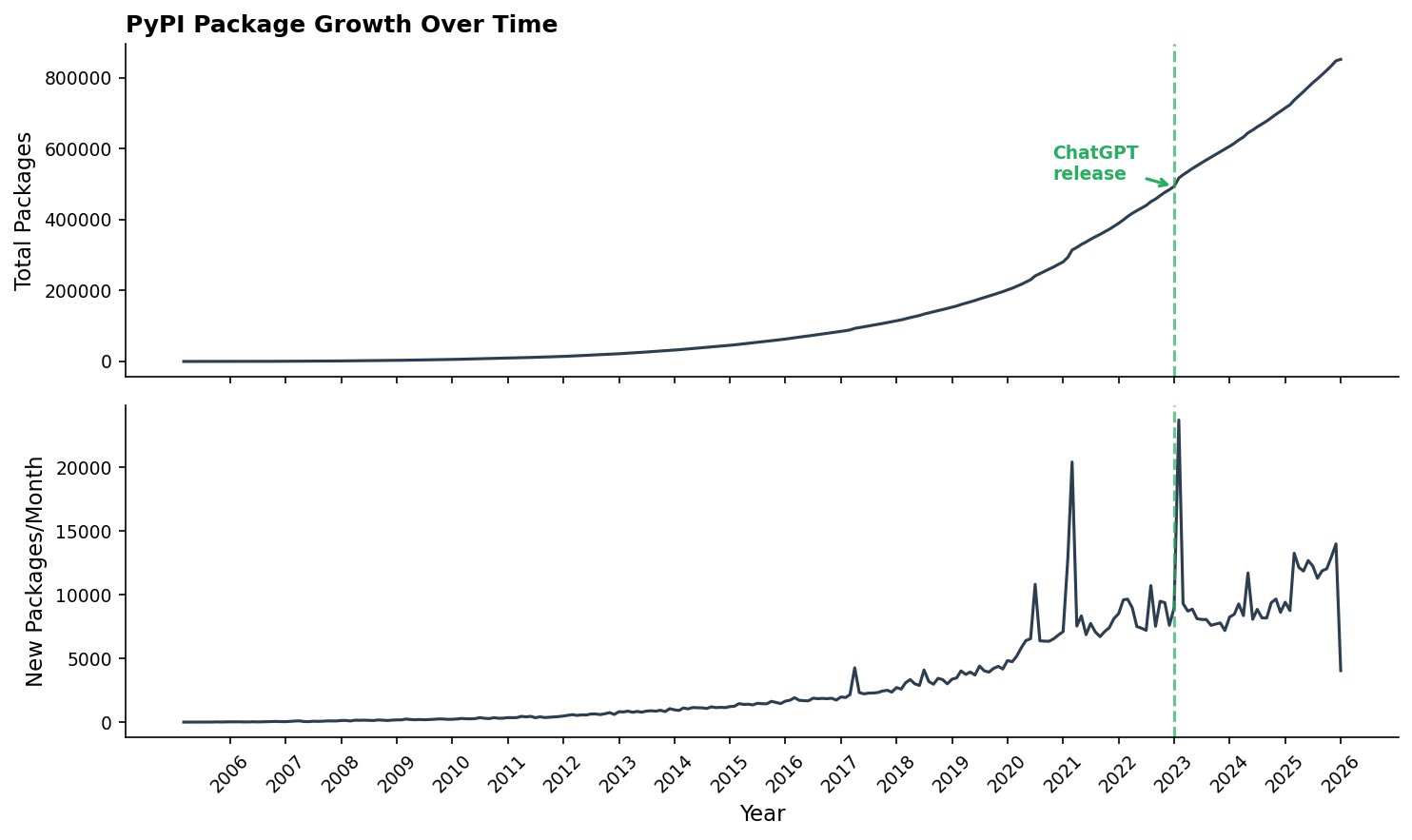
Let’s check the data. We’ll look at PyPI, the central repository for Python packages, and look at how that number has grown over time.
Counting packages
There it is, see it? The release of ChatGPT. Does it look like an epochal revolution of software productivity on the upper chart? No.
There are a few spikes in the lower chart showing new packages/month, in what you might call the “AI era” of 2020 onward. But those reflect spam and malware floods, not genuine package creation.1
Counting updates
But, you might say, package creation is not the right measure. Anyone can create a “package” which is nothing but a hello world and upload it to PyPI. This is always easier to do than creating something durable which people use. So we want to look at “real” packages, packages which are actually downloaded and, presumably, updated over time.
So let’s consider a different chart. We’ll start by filtering to the 1,500 most downloaded Python packages on PyPI2, so that we can be sure we are considering real libraries in actual use. Then we’ll plot the median annual release frequency3 over time.
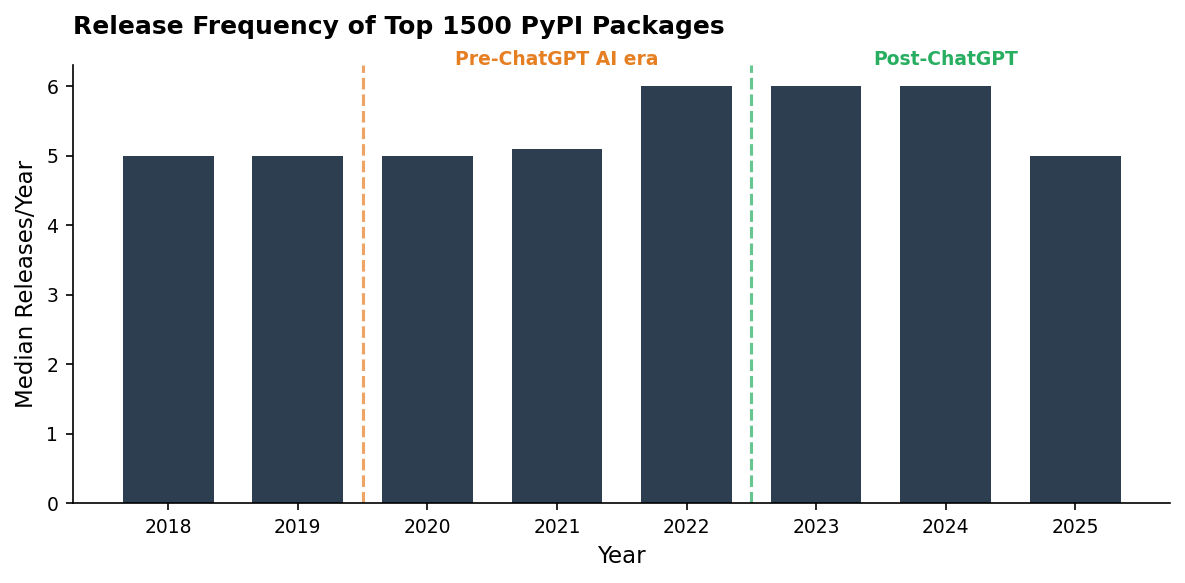
Hmm. That’s also not too dramatic. In 2022, the median release frequency went from 5 to 6, and then back down to 5 in 2025, when the models were stronger than ever.
Slicing by age
But maybe we’re not looking deeply enough? Let’s take the set of all our most downloaded packages, and divide it into three cohorts depending on their first release — that is, depending on when they were born. We’ll have the pre-AI packages, the pre-ChatGPT packages, and finally the post-ChatGPT packages.4
Maybe the benefits of AI are only really available when you are starting a project. This might plausibly be the case if AI works better when starting from a blank slate. In this case, we’d expect to see the AI effect only in the second two cohorts, the “AI native” packages.
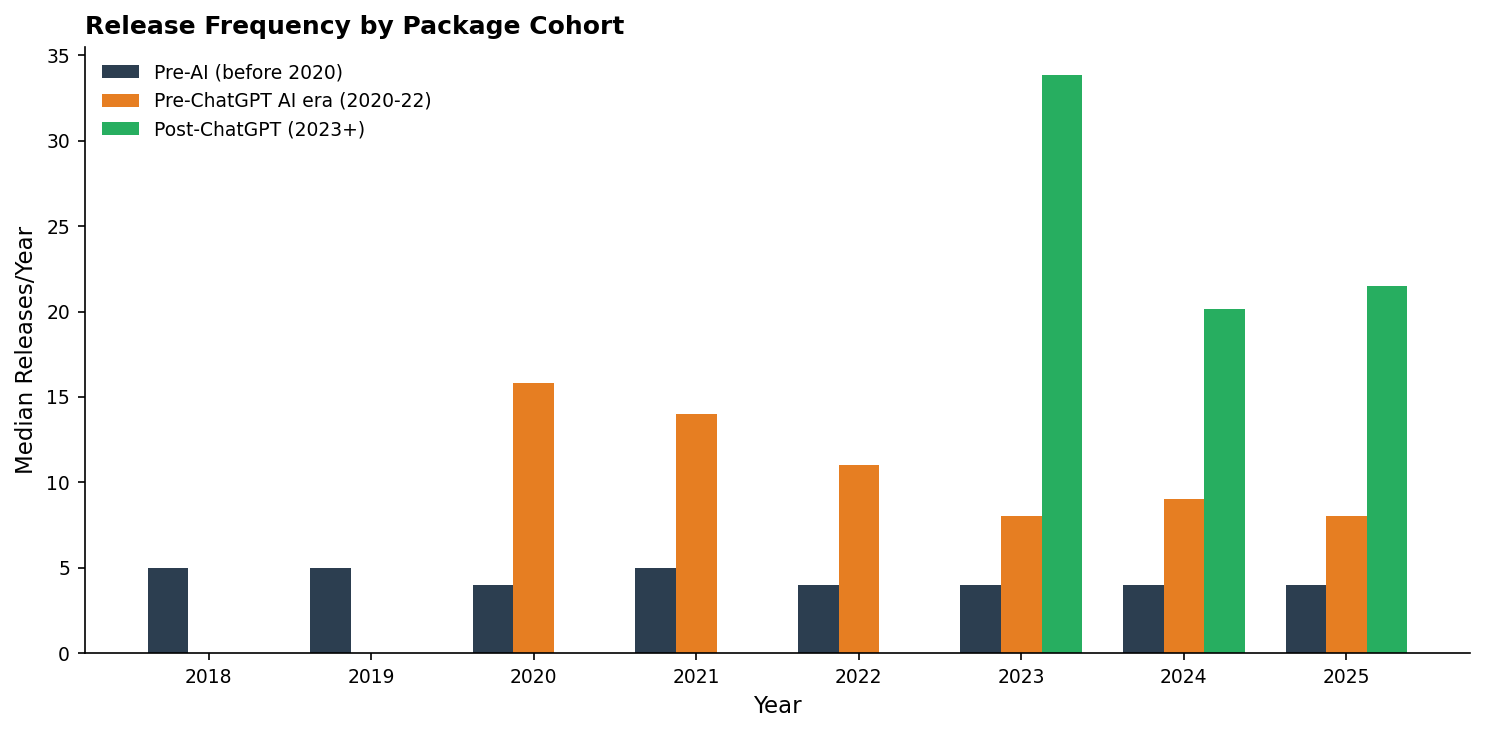
And there it is! Or at least, there’s something. There has been at least a ~3x increase in the median release frequency for packages born since the advent of ChatGPT, reaching as high as 35 releases/year in 2023, which is 7x higher than the pre-AI cohort.
Controlling for youth
But is this simply because young packages always naturally get updated more frequently? Let’s check by also splitting the Pre-AI era into multiple cohorts.
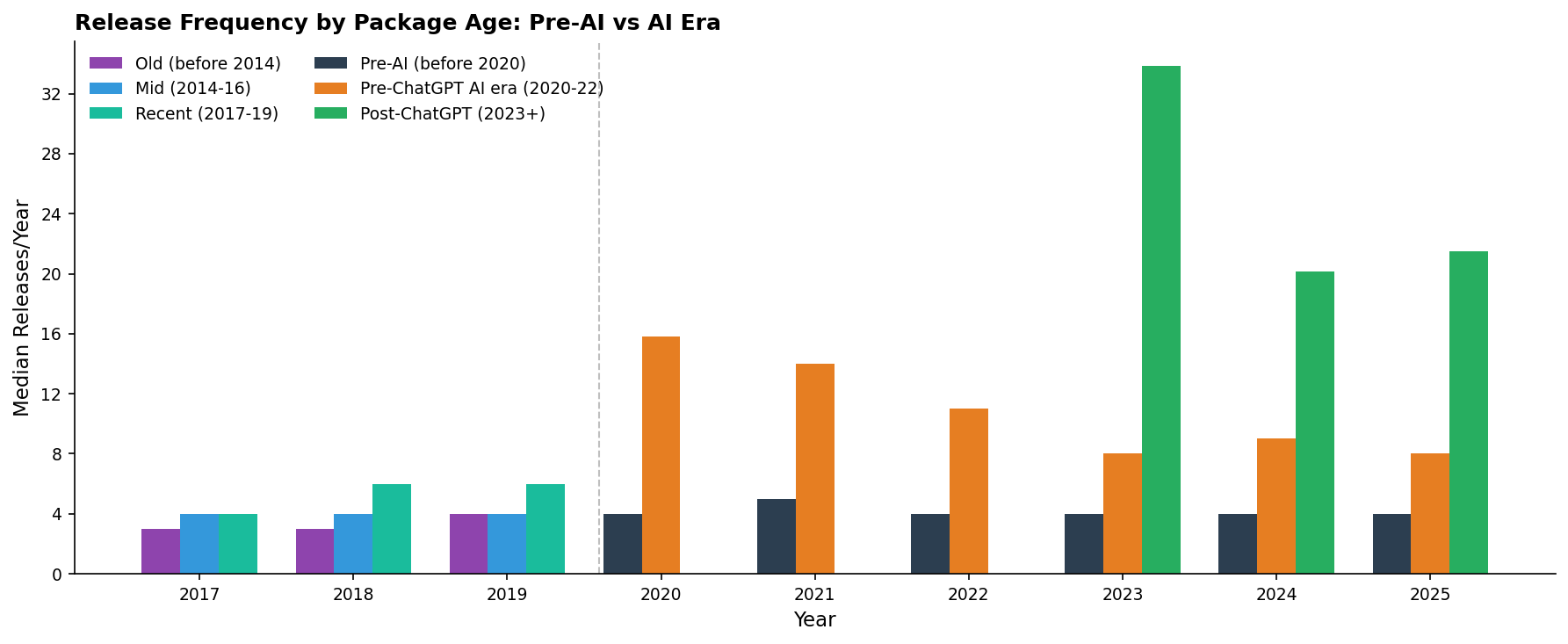
The left side shows the pre-AI era and, indeed, packages which were young at that time were updated more frequently than their elders in that group. But the effect was modest. The right side shows the AI era: the young-vs-old gap has widened dramatically.
This is not just “normal young package behavior”; something additional is happening. But what’s driving it?
It’s about AI
Let’s split packages by whether they’re about AI or not, by classifying based on the package’s description.5
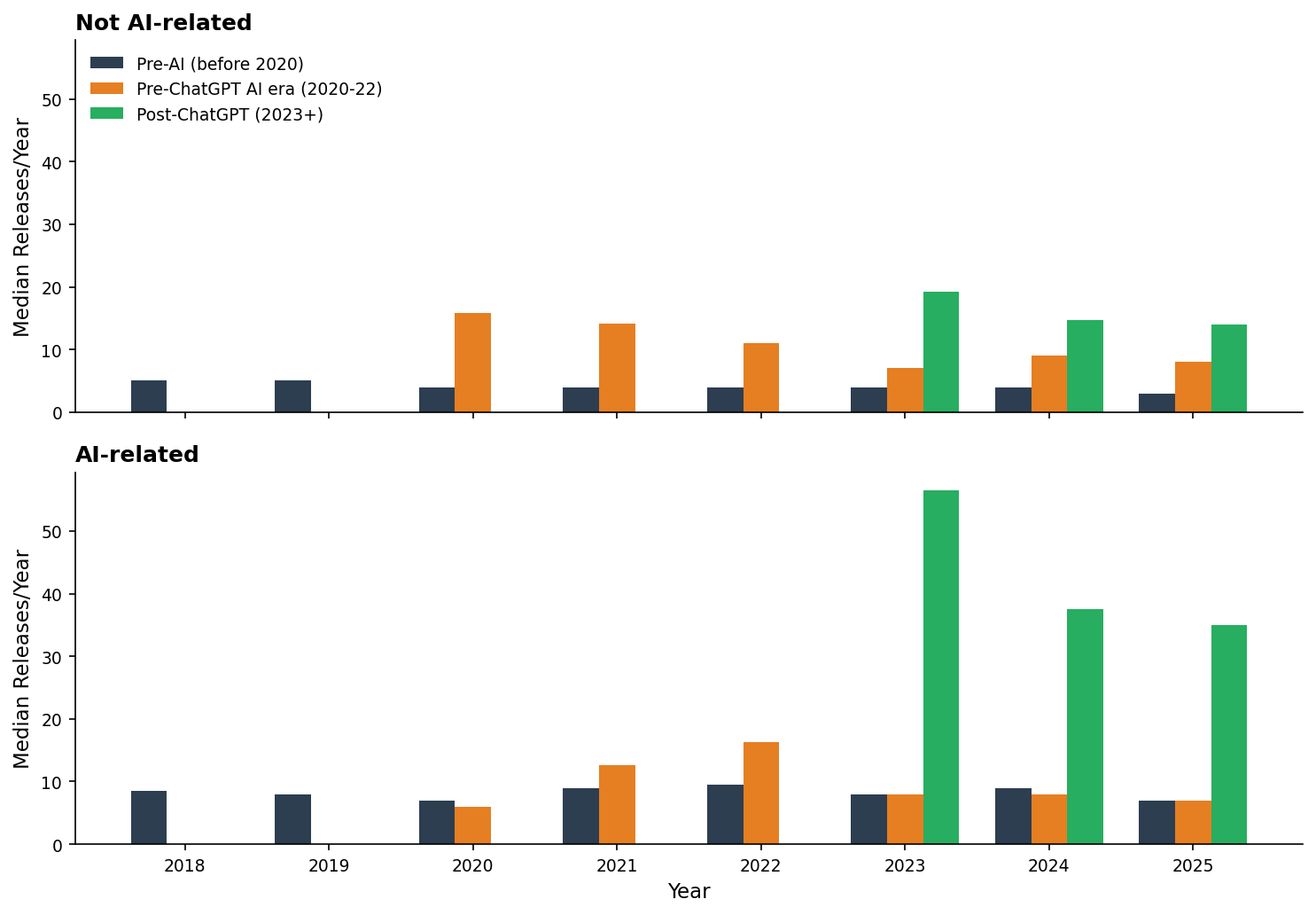
This split reveals a lot! The packages which are not about AI look much more like the pre-AI era, in the relative increase in frequency of young vs old packages. That increase is still higher, but it’s not mind-bending.
In contrast, it’s the packages which are about AI which show the massive increase in release frequency. For example, they reached a median level of around 55 releases per year in 2023.6 This is an increase of more than 5x vs older packages in that year (or, a 175% AI boost off an assumed 100% youth boost).
In short, for some reason, newly created packages about AI are being updated much more frequently.
Of course the interesting question is, why?
So what?
Before considering what’s causing this, let’s recap the evidence:
There is no obvious increase in the rate of package creation as a whole, and only a marginal increase in the rate of package updates as a whole.
However, there is some increase in the update frequency of packages which were created after AI, which are not about AI.
And there is a huge increase in the update frequency of PyPI packages which were created after AI, and which are about AI.
As goes without saying this data is imperfect. But it still seems easy to say confidently what is not happening, and to at least offer some reasonable interpretations about what is going on.7
Here are three questions which target why this might be happening.
Is AI massively boosting developer productivity across the board?
No. We are not seeing indications that developers as a whole are 100x or even 10x more productive. The bumper crop of new packages, or new package updates, just does not exist!
Relax. You are not missing a party that literally everyone else was invited to.
Are some developers building much faster, by using AI?.
Perhaps? But the visible aggregate effect is still so modest, that if some devs are getting this big boost, there certainly isn’t many of them. Or else the purported boost is not really that big. What we see in aggregate is a no uptick in package update frequency.
However, we do see a boost in newly-created packages, and super highly concentrated in newly-created packages about AI.
Are people building an enormous amount of software for using AI?
Yes, yes they are. The huge jump in update frequency for recent packages about AI is really the headline effect here. This is the puzzle that needs to be explained.
So, let’s ask again, why? Why is this jump concentrated in software about AI? We do have two hypotheses:
AI “skill issue”. Maybe people building AI tools are also the ones most likely to know how to use AI effectively. This would produce an uneven effect on productivity, where people building AI tools also built faster. In fact, we build AI tools here at AnswerAI and our experience is that, yes, they do boost productivity. But sadly, this effect is not the crazy 30x jump one sees in the PyPi update frequencies, and the biggest effect depends on also having solid expertise in software engineering. So we doubt that an “AI skill issue” explains most of the jump.
Money and hype 🤑💰. An enormous amount of funding and enthusiasm has flowed into AI, and it is being converted into (amongst other things) PyPI packages. Maybe it’s not that developers on these packages have gotten more productive. It’s just that there are more of them, and they can work more hours, because there is more money to pay for that work. On this view, it’s not so much that AI is making developers superhuman, but that supercharged interest in AI is paying for a higher rate of creation and iteration about AI.
Alas, the data do not tell us which of these effects is larger.
But what we can say is that the main measurable impact of the generative AI revolution, so far, at least on the PyPi ecosystem, is not a Cambrian explosion in all software. But a sharp and concentrated burst in the updating of packages that are themselves part of the AI ecosystem.
Footnotes
See the official pypi blog: Inbound Malware Volume Report↩︎
We used the top 1,500 packages by download count in the last month of 2025, as downloaded from hugovk’s monthly dump of 15,0000 top-pypi-packages January 19th 2026. The top 10% of that dataset covers 90% of all downloads.↩︎
We annualized release frequency for a package’s first active year. As a robustness check, to avoid inflating estimates for packages with short histories, we redid the analysis and excluded packages active for only 1-2 months, and saw similar patterns.↩︎
As a robustness check, we downsampled older cohorts to match the size of recent cohorts, and saw similar patterns.↩︎
We used an GPT5.2 to classify packages as “AI-related” or not based on their PyPI description. This is imperfect but directionally useful.↩︎
This figure is robust to our methodological choices: downsampling older cohorts and excluding short-lived packages both preserve the pattern.↩︎
All analysis code and data is available at https://github.com/AnswerDotAI/pypi-analysis.↩︎