# rerankers: A Lightweight Python Library to Unify Ranking Methods
Benjamin Clavié
2024-09-16
## TL;DR
We’ve released (a while ago, now, with no further report of any major
issues, warranting this blog post!) `rerankers`, a low-dependency Python
library to provide a unified interface to all commonly used re-ranking
models. It’s available on GitHub
[here](https://github.com/answerdotai/rerankers).
In this post, we quickly discuss:
1. Why two-stage pipelines are so popular, and how they’re born of
various trade-offs.
2. The various methods now commonly used in re-ranking.
3. `rerankers` itself, its design philosophy and how to use it.
## Introducing `rerankers`: why and how?
In Information Retrieval, the use of **two-stage pipelines** is often
regarded as the best approach to maximise retrieval performance. In
effect, this means that a small set of candidate documents is first
retrieved by a computationally efficient retrieval method, to then be
re-scored by a stronger, generally neural network-based, model. This
latter stage is widely known as `re-ranking`, as the list of retrieved
documents is re-ordered by the second model.
However, using re-ranking models is often more complex than it needs to
be. For a starter, there is a lot of methods, with their different pros
and cons, and it’s often difficult to know which one is the best for a
given use case. This issue is compounded by the fact that most of these
methods are implemented in sometimes wildly different code-bases. As a
result, trying out different approaches can require a non-trivial amount
of work, which would be better spent in other areas.
A while back, I posted [a quick overview of the “best starter re-ranking
model” for every use case, based on latency requirements and environment
constraints on
Twitter](https://x.com/bclavie/status/1765312881120153659), to help
people get started in their exploration. It got unexpectedly popular, as
it’s quite a difficult environment to map. Below is an updated version
of that chart, incorporating a few new models, including our very own
[answerdotai/answer-colbert-small-v1](https://huggingface.co/answerdotai/answer-colbert-small-v1):
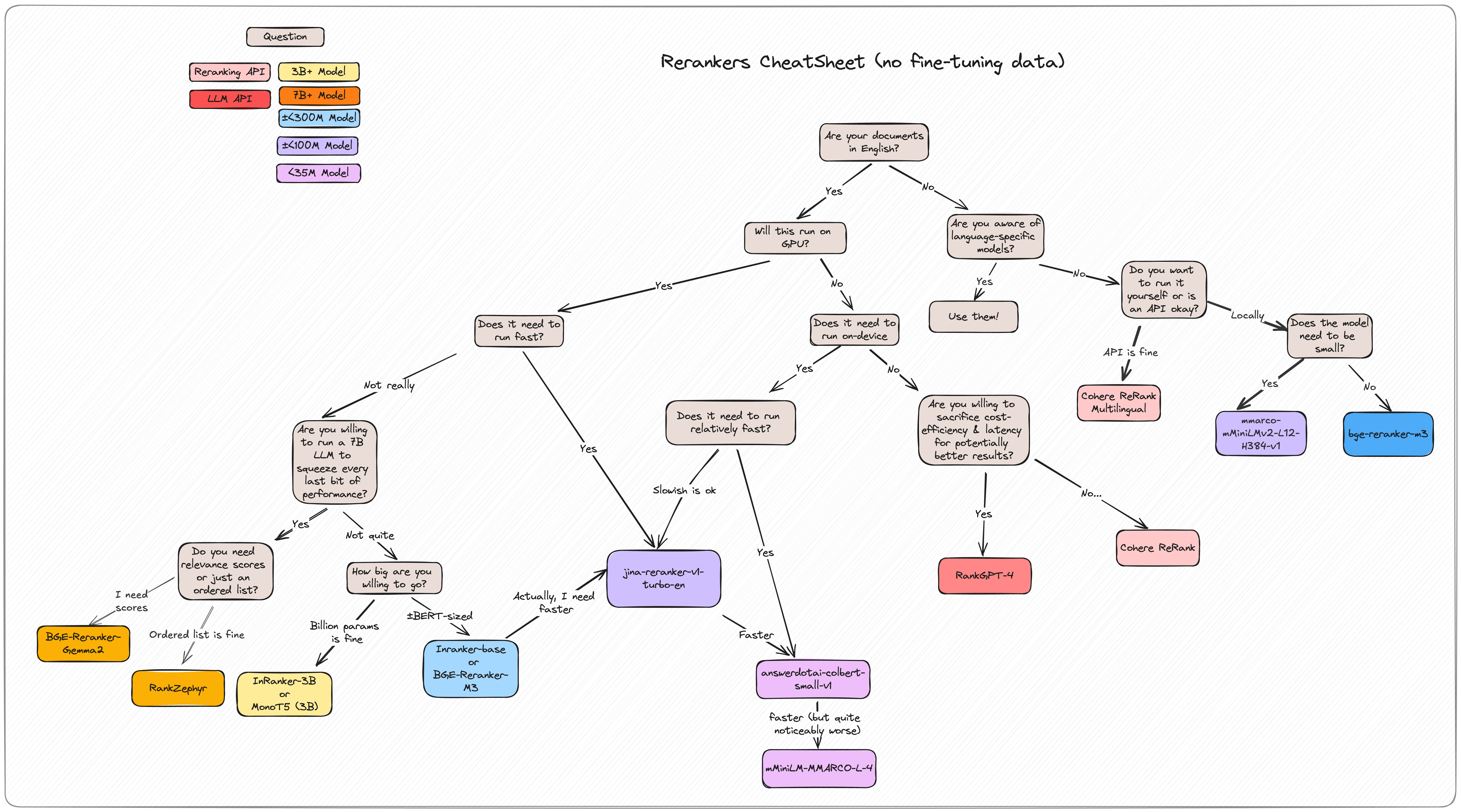
As you can see, even figuring out your starting point can be
complicated! In production situations, this often means that re-ranking
gets neglected, as the first couple solutions are make-or-break: either
they’re “good enough” and get used, even if suboptimal, or they’re not
good enough, and re-ranking gets relegated to future explorations.
To help solve this problem, we introduced the
[rerankers](https://github.com/answerdotai/rerankers) library.
`rerankers` is a low-dependency, compact library which aims to provide a
common interface to all commonly used re-ranking methods. It allows for
easy swapping between different methods, with minimal code changes,
while keeping a unified input/output format. `rerankers` is designed
with extensibility in mind, making it very easy to add new methods,
which can either be re-implementations, or simply a wrapper for existing
code-bases.
In this blog post, inspired by our [`rerankers` demo
paper](https://arxiv.org/abs/2408.17344), we’ll discuss: 1. Why
two-stage pipelines are so popular, and how they’re born of various
trade-offs. 2. The various methods commonly used in re-ranking 3.
`rerankers` itself, how to use it and its design philosophy
## Two-Stages, why?
So, why exactly are two-stage pipelines so popular? What makes it so
that we need to break the retrieval step into two sub-steps, rather than
having a single, all-powerful search?
The problem essentially boils down to the trade-off between performance
and efficiency. The most common way to do retrieval is to use a
lightweight approach, either keyword-based (BM25), or based on
neural-network generated embeddings. In the case of the latter, you will
simply embed your query with the same model that you previously embedded
your documents with, and will use cosine similarity to measure how
“relevant” certain documents are to the query: this is what gets called
“vector search”.
In the case of both keyword-based retrieval and vector search, the
computational cost of the retrieval step is extremely low: you, at most,
need to run inference for a single, most likely short, query, and very
computationally cheap similarity computations. However, this comes at a
cost: this retrieval step is performed in a “cold” way: your documents
were processed a long time ago, and their representations are frozen in
time. This means that they’re entirely unaware of the information you’re
looking for with your query, making the task harder, as the model is
expected to be able to represent both documents and queries in a way
that’ll make them easily comparable. Moreover, it has to do so without
even knowing what kind of information we’ll be looking for!
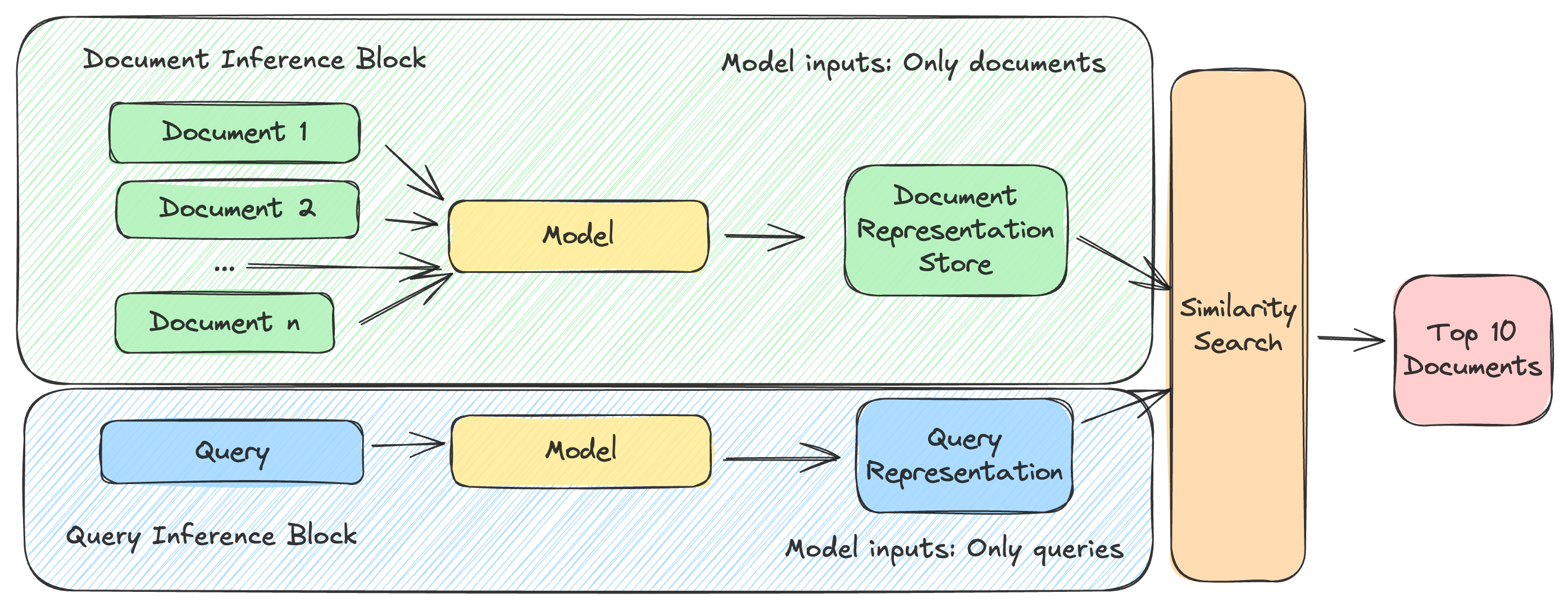
A simplified view of the single-stage
retrieval pipeline.
This is where re-ranking comes in. A ranking model, typically, will
always consider both queries and documents at inference-time, and will
accordingly rank the documents by relevance. This is great: your model
is both query-aware and document-aware at inference time, meaning it can
capture much more fine-grained interactions between the two. As a
result, it can capture nuances that your query might require which would
otherwise be missed.
However, the computational cost is steep: in this set-up,
representations *cannot* be pre-computed, and inference must be run on
all potentially relevant documents. This makes this kind of model
completely unsuitable for any sort of large, or even medium, scale
retrieval task, as the computational cost would be prohibitive.
You can probably see where I’m going with this, now: why not combine the
two? If we’ve got families of models that are able to very efficiently
retrieve potentially relevant documents, and another set of models which
are much less efficient, but able to rank documents more accurately, why
not use both?
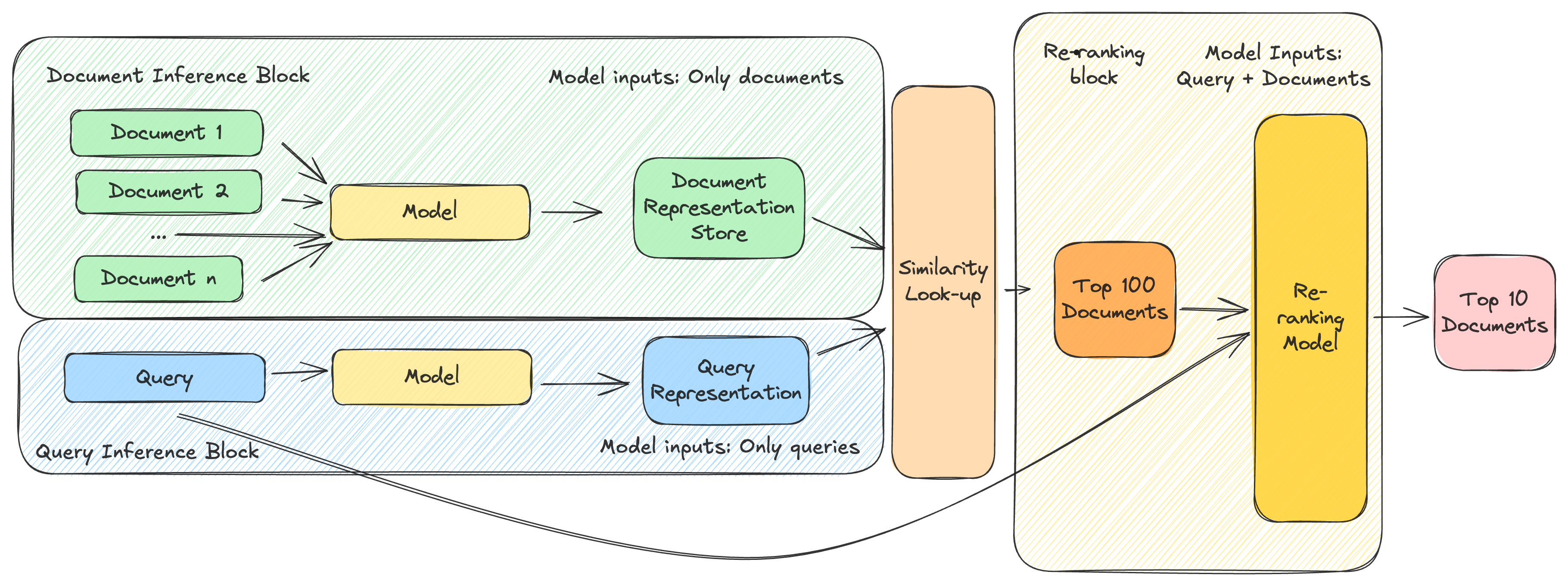
By using the former, you can generate a much more restricted set of
candidate documents, by fetching the 10, 50, or even 100 most “similar”
documents to your query. You can then use the latter to re-rank this
manageable-sized set of documents, to produce your final ordered
ranking:
A simplified view of the
retrieve-then-rerank two-stage pipeline.
This is essentially what two-stage pipelines boil down to: they work
around the trade-offs of various retrieval approaches to produce the
best possible final ranking, with fast-but-less-accurate retrieval
models feeding into slow-but-more-accurate ranking models.
## The many faces of re-ranking
With this being said, there’s another aspect to discuss to understand
why `rerankers` is useful: the different types of re-ranking models that
exist.
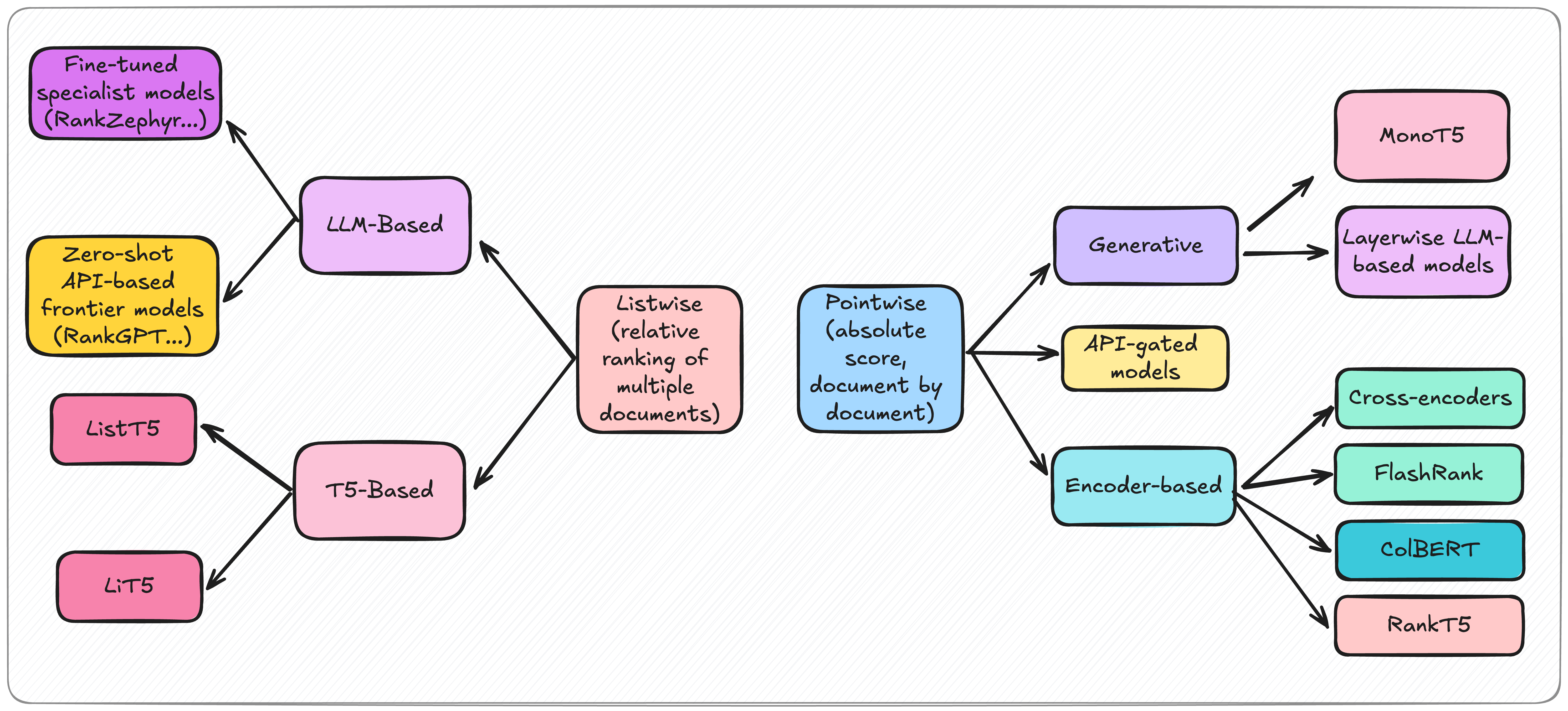
For a long time, re-ranking was dominated by cross-encoder models, which
are essentially just binary sentence classification models, using
BERT-like models: these models are given both the query and a document
as input, and they output a “relevance” score for the pair, which is the
probability it assigns to the positive class. This approach, outputting
a score for each query-document pair, is called **Pointwise**
re-ranking.
However, as time went on, an increasing number of new, powerful
re-ranking methods have merged. One such example is MonoT5, where the
model is trained to output a “relevant” or “irrelevant” token, with the
likelihood of the “relevant” token being outputted being used as a
relevance score. This line of work has recently been revisited with
LLMs, with models such as BGE-Gemma2 calibrating a 9 billion parameter
model to output relevance scores through the log-likelihood of the
“relevant” token.
Another example is the use of late-interaction retrieval models, such as
our own
[answerdotai/answer-colbert-small-v1](https://huggingface.co/answerdotai/answer-colbert-small-v1)
(read more about it
[here](https://www.answer.ai/posts/2024-08-13-small-but-mighty-colbert.html)),
repurposed as re-ranking models.
A non-exhaustive overview of the current
most-used approaches to re-ranking, broken down by family.
Other methods do not directly output relevance scores, but simply
re-order documents by relevancy. These are called **Listwise** methods:
they take in a list of documents, and re-output the document with an
updated order, based on relevance. This has traditionally been done
using T5-based models. However, recent work is now exploring the use of
LLMs for this, either in a zero-shot fashion (RankGPT), or by
fine-tuning smaller models on the output of frontier models
(RankZephyr).
Ultimately, this section could go on for much longer: the main point is
that there exist many different approaches to re-ranking, each with
their own pros and cons. The more annoying truth is also that there
currently is no silver bullet re-ranking method that’ll work for all use
cases: you have to figure out exactly which one works best for your
situation (and sometimes, that even involves fine-tuning your own!).
Even more annoying is that doing so requires quite a lot of code
iteration, as most of the methods listed above are not implemented in a
way that’ll allow for easy swapping out of one for another. They all
expect inputs formatted in a certain way while also outputting scores in
their own way.
This leads us to the main point of `rerankers`: it aims to provide a
common interface to all of these methods, making it easy to try out
different approaches and find the best one for your use case.
## rerankers
Now that we’ve established the **why** of `rerankers`, let’s discuss
**how** it actually works.
`rerankers` as a library follows a clear design philosophy, with a few
key points:
- As with our other retrieval libraries,
[RAGatouille](https://github.com/answerdotai/ragatouille) and
[Byaldi](https://github.com/answerdotai/byaldi), the goal is to be
fully-featured while requiring the **fewest lines of code possible**.
- It aims to **provide support for all common re-ranking methods**,
through a **common interface**, without **any retrieval performance
degradation** compared to official implementations.
- `rerankers` must be **lightweight** and **modular**. It is
low-dependency, and it should allow users to only install the
dependencies required for their chosen methods.
- It should be **easy to extend**. It should be very easy to add new
methods, whether they’re custom re-implementations, or wrappers around
existing libraries.
In practice, these objectives are achieved by structuring the
application around just two main exposed classes: the `Reranker` class,
which is the main class used to perform re-ranking, and `RankedResults`,
itself containing a list `Result`, which are fully-transparent objects
used to store results along with associated useful information.
### Reranker
Every method supported by `rerankers` is implemented around the
`Reranker` class. It is used as the main interface to load models, no
matter the underlying implementation or requirements.
You can initialise a `Reranker` with a model name or path, with full
HuggingFace Hub support, and a `model_type` parameter, which specifies
the type of model you’re loading. By default, a `Reranker` will attempt
to use the GPU and half-precision if available on your system, but you
can also pass a `dtype` and `device` (when relevant) to further control
how the model is loaded. API-based methods can be passed an `API_KEY`,
although the better way is to use the API provider’s preferred
environment variable.
Loading a `Reranker` is very straightforward:
``` python
# Initialising a BERT-like cross-encoder model
ranker = Reranker(MODEL_NAME_OR_PATH, model_type='cross-encoder')
# MonoT5-based models, with a specified dtype
ranker = Reranker(MODEL_NAME_OR_PATH, model_type = "t5", dtype=torch.float32)
# Flashrank models, with a specified device
ranker = Reranker(MODEL_NAME_OR_PATH, model_type='flashrank', device="cpu")
# ... and so on
```
Once loaded, the class has a single exposed method, `rank()`, which
takes in a query and a set of documents. No matter the underlying
implementation, it will return a `RankedResults` object containing the
re-ranked documents. Using `rank()` is just as straightforward as
loading the model:
``` python
# Every Reranker then has a single `rank` method, which performs inference.
results = ranker.rank(query="Who wrote Spirited Away?", docs=["Spirited Away [...] is a 2001 Japanese animated fantasy film written and directed by Hayao Miyazaki. ", "Lorem ipsum..."], doc_ids=[0,1])
```
### RankedResults
Similarly to how `Reranker` serves as a single interface to various
models, `RankedResults` objects are a centralised way to represent the
outputs of various models, themselves containing `Result` objects. Both
`RankedResults` and `Result` are fully transparent, allowing you to
iterate through `RankedResults` and retrieve their associated
attributes.
`RankedResults` and `Result`’s main aim is to serve as a helper. Most
notably, each `Result` object stores the original document, as well as
the score outputted by the model, in the case of pointwise methods. They
also contain the document ID, and, optionally, document meta-data, to
facilitate usage in production settings. The output of `rank()` is
always a `RankedResults` object, and will always preserve all the
information associated with the documents:
``` python
# Ranking a set of documents returns a RankedResults object, preserving meta-data and document-ids.
results = ranker.rank(query="I love you", docs=["I hate you", "I really like you"], doc_ids=[0,1], metadata=[{'source': 'twitter'}, {'source': 'reddit'}])
results
> RankedResults(results=[Result(document=Document(text='I really like you', doc_id=1, metadata={'source': 'twitter'}), score=-2.453125, rank=1), Result(document=Document(text='I hate you', doc_id=0, metadata={'source': 'reddit'}), score=-4.14453125, rank=2)], query='I love you', has_scores=True)
```
You will notice that `RankedResults`’s main purpose is to contain
`Result` objects in an easily accessible way, but it also has two useful
meta-attributes: `query`, which contains the text of the original query,
and `has_scores`, which allows you to easily check whether or not the
re-ranking method you’re using actually outputs scores, or just
re-orders documents.
While you can directly iterate through `RankedResults`, you can also use
it to directly access information that is useful for various use cases:
via the `top_k` method, you can directly retrieve only the top `k`
results, which is useful if you’re only interested in the most relevant
documents:
``` python
# RankedResults comes with various built-in functions for common uses, such as .top_k(), and all attributes are accessible:
results.top_k(1).text
> 'I really like you'
```
Alternatively, if you’re using the library to generate scores for
distillation purposes, you can also directly fetch the score of any
given \[query, document\] pair by calling `get_score_by_docid(doc_id)`
on the appropriate document id:
``` python
# It's also possible to directly fetch the score given to a single document
results.get_score_by_docid(0)
> -4.14453125
```
### Modularity & Extensibility
**Modularity** `rerankers` is designed specifically with ease of
extensibility in mind. All approaches are independently-implemented and
have individually-defined sets of dependencies, which users are free to
install or not based on their needs. Informative error messages are
shown when a user attempts to load a model type that is not supported by
their currently installed dependencies.
**Extensibility** As a result, adding a new method simply requires
making its inputs and outputs compatible with the `rerankers`-defined
format, as well as a simple modification of the main `Reranker` class to
specify a default model. This approach to modularity has allowed us to
support all the approaches with minimal engineering efforts. We fully
encourage researchers to integrate their novel methods into the library
and will provide support for those seeking to do so.
### `rerankers` within the ecosystem
`rerankers`‘s main aim is to act as a unifying re-ranking inference
interface, which suits the needs of both researchers and practitioners.
Up until now, we are not aware of any library with a similar aim to
`rerankers`: as such, it is not intended to compete with any existing
libraries. While extensive IR frameworks, such as
[PyTerrier](https://github.com/terrier-org/pyterrier) or
[Pyserini](https://github.com/castorini/pyserini) do exist, they largely
focus on reproducible research use cases, leading to a very different
design philosophy from `rerankers`’ low footprint approach.
Finally, `rerankers` aims to always preserve the performance of the
methods it implements. In some cases, the backend implementation is the
official one, ensuring full performance parity. In other cases,
`rerankers` implementation may be a simplified one, removing unnecessary
dependencies and components. In these cases, we conducted top-1000
reranking evaluations on three commonly used datasets[1].
For most models within the library, we achieve performance parity with
the existing implementation code and reported results from the
literature. A notable exception is RankGPT, where our results over all
runs were noticeably different from the paper’s reported results[2].
However, the official implementation’s results largely matched our own
during our runs. This likely indicates that the issue is not with our
implementation, but the general difficulty of reproducing experiments
conducted with unreleased, API-only models such as the GPT family.
## Takeaways
I originally hoped that I could delegate this bit to
tabtabtabtabtab Cursor, but it very quickly became apparent that
Homer Simpson it is not the markdown genius I thought it was:

Anyway, here are the quick take-aways from this blog post:
- Two-stage pipelines are popular, because they let you use strong
models that can capture finer aspects of your query-document
relationships, which would be prohibitively slow if used on their own.
- There are *a lot* of different approaches to re-ranking, and we’ve
only covered the main and most recent ones!
- On top of there being a lot, there’s no cookie-cutter answer: as with
all things retrieval, it very much depends on **your data** and **your
use case**.
- We introduce `rerankers` to help you navigate this ecosystem: now, you
can use (most) of the fancy re-ranking methods with a single,
low-dependency library! All it takes to re-rank documents is two lines
of code, and switching between methods is as simple as changing a
couple parameters in your model loading call.
- `rerankers` is built to easily slot-in anywhere, and support new
methods really easily. In fact, there’s already [some academic
work](https://arxiv.org/abs/2406.10806) which has made `rerankers` its
official re-ranking codebase!
- `rerankers` is open-source and available at
[github.com/answerdotai/rerankers](https://github.com/answerdotai/rerankers).
[1] A subset of the MS Marco passage retrieval dataset, as well as
Scifact and TREC-Covid, all three being subsets of the BEIR benchmark.
[2] The results we obtained were worse than the official ones in 4 runs,
and better in 1.