# More=Better?
Jonathan Whitaker
2024-05-17

In this post I want to share a few quick experiments to show something
that is both obvious and also perhaps underappreciated: you can get a
sizeable quality boost from a generative model by generating MORE. For
example, generating more samples and picking the best ones (with a few
caveats). I’ll show this in action and talk about some of the
implications.

## Pic The Best

Let’s start on images. Imagine you have two competing text-to-image
systems. Both use an identical model, but when A generates an image it
only generates and shows one sample, while B generates 4 and picks the
best one. What percentage of the time will you prefer the image from B?
80% of the time! Newer models are lucky if they can brag about a 5%
improvement in win-rate over the competition (see below) so an 80% win
rate is huge. Now do the maths for a case where we generate 100 images
and pick the best…

<figure>
<img
src="https://images.squarespace-cdn.com/content/v1/6213c340453c3f502425776e/19acc961-3e42-413f-b495-450803aba582/baseline_comp.jpg?format=2500w"
alt="Image model win rates from the Stable Diffusion 3 launch post, where a win-rate of a few percent is a big deal…" />
<figcaption aria-hidden="true">Image model win rates from the Stable
Diffusion 3 launch post, where a win-rate of a few percent is a big
deal…</figcaption>
</figure>

Of course, there’s a catch. “The best one” in the previous paragraph
assumed we have a way of picking in advance which of the four you’ll
prefer. Imagine instead that B generates 4 images and returns one of the
four at random. Now the win-rate is back to 50%. And worse, it takes 4x
as long! So the only way our scheme has any legs is if we can somehow
pick images in a way that at least roughly aligns with what humans
(you’re a human right?) will prefer.

One useful measure is the CLIP similarity score between the image and
the prompt, which tends to track well with how accurately the image
represents the prompt. CLIP was used to pick the best images out of 256
candidates in the original DALL-E text-to-image system! Another option
is to use a model trained to predict human ratings or preferences - I’m
a fan of [PickScore](https://github.com/yuvalkirstain/PickScore) which
correlates well with aesthetics in my experience.

<div>

</div>

<div>

</div>

Now, how can we spend even more inference time compute to get this
system to deliver even better results? We have big LLMs now that can do
things like re-write the prompt, and since some are ‘multimodal’ we can
also show them the results and use that to modify the prompt to fix any
potential flaws. With this we’re moving from ‘generate N pick one’ to
something more like the ‘flow engineering’ the cool kids like to talk
about, creating multi-step processes that refine the result. Think about
something like this:

    Your task is to evaluate whether the following image accurately follows the prompt.
    Prompt: {image_prompt}
    If the image follows the prompt well, respond with 'yes'. 
    If not, suggest a better prompt...

[This
notebook](https://github.com/johnowhitaker/moar_ai_examples/blob/main/moar_image_example.ipynb)
shows the first step (using PickScore and CLIP to rank images) - I leave
it to your imagination to take it from there!

## Text

How can we map similar ideas to text? As a first test I was curious how
well best-of-N would work for text generation. With AlpacaEval-2 as the
metric, let’s see how much we can boost Llama 3 8B. I used
[this](https://huggingface.co/sfairXC/FsfairX-LLaMA3-RM-v0.1) reward
model (which itself is also a fine-tune of Llama 3 8B, making this
something we could reasonably imigine being a lightweigt adapter) to
score the candidate completions. Best-of-10 vs the baseline boost the
win rate from 20.5% to 29.0%. Not bad!
([Here](https://github.com/johnowhitaker/moar_ai_examples/blob/main/best-of-10-llama-3-8b.ipynb)
is a notebook showing my approach if you’re curious about the details.)

<table>
<thead>
<tr>
<th>Model</th>
<th>win_rate</th>
<th>avg_length</th>
</tr>
</thead>
<tbody>
<tr>
<td>gpt4_turbo</td>
<td>50.0</td>
<td>2049</td>
</tr>
<tr>
<td>Yi-34B-Chat</td>
<td>29.7</td>
<td>2123</td>
</tr>
<tr>
<td><strong>Llama 3 8B (Best of 10)</strong></td>
<td><strong>29.0</strong></td>
<td><strong>1895</strong></td>
</tr>
<tr>
<td>gpt4</td>
<td>23.6</td>
<td>1365</td>
</tr>
<tr>
<td>mistral-medium</td>
<td>21.9</td>
<td>1500</td>
</tr>
<tr>
<td><strong>Llama 3 8B (Default)</strong></td>
<td><strong>20.5</strong></td>
<td><strong>1795</strong></td>
</tr>
<tr>
<td>Mixtral-8x7B-Instruct-v0.1</td>
<td>18.3</td>
<td>1465</td>
</tr>
<tr>
<td>claude-2</td>
<td>17.2</td>
<td>1069</td>
</tr>
<tr>
<td>gemini-pro</td>
<td>16.8</td>
<td>1315</td>
</tr>
<tr>
<td>tulu-2-dpo-70b</td>
<td>16.0</td>
<td>1418</td>
</tr>
<tr>
<td>claude-2.1</td>
<td>15.7</td>
<td>1096</td>
</tr>
<tr>
<td>Mistral-7B-Instruct-v0.2</td>
<td>14.7</td>
<td>1676</td>
</tr>
<tr>
<td>llama-2-70b-chat-hf</td>
<td>13.9</td>
<td>1790</td>
</tr>
<tr>
<td>llama-2-13b-chat-hf</td>
<td>7.7</td>
<td>1513</td>
</tr>
<tr>
<td>llama-2-7b-chat-hf</td>
<td>5.0</td>
<td>1479</td>
</tr>
<tr>
<td>text_davinci_001</td>
<td>2.8</td>
<td>296</td>
</tr>
</tbody>
</table>

I’m not the first to think of this approach - looking at the full
[leaderboard](https://tatsu-lab.github.io/alpaca_eval/) reveals a number
of entries with names like `Snorkel (Mistral-PairRM-DPO+best-of-16)`
which have obviously taken a similar approach. With LLM-judged
leaderboards like this we must always be cautious translating scores to
true performance… Which brings up a good, more general question: how
should we rank/score outputs if we want to bring this same approach to
bear on other text generation tasks? And how can we improve on the
simple ‘best of N’ approach?

<figure>
<img src="images/x_of_thought.png"
alt="‘X’ of thought: different approaches to using more inference compute before commiting to a final answer" />
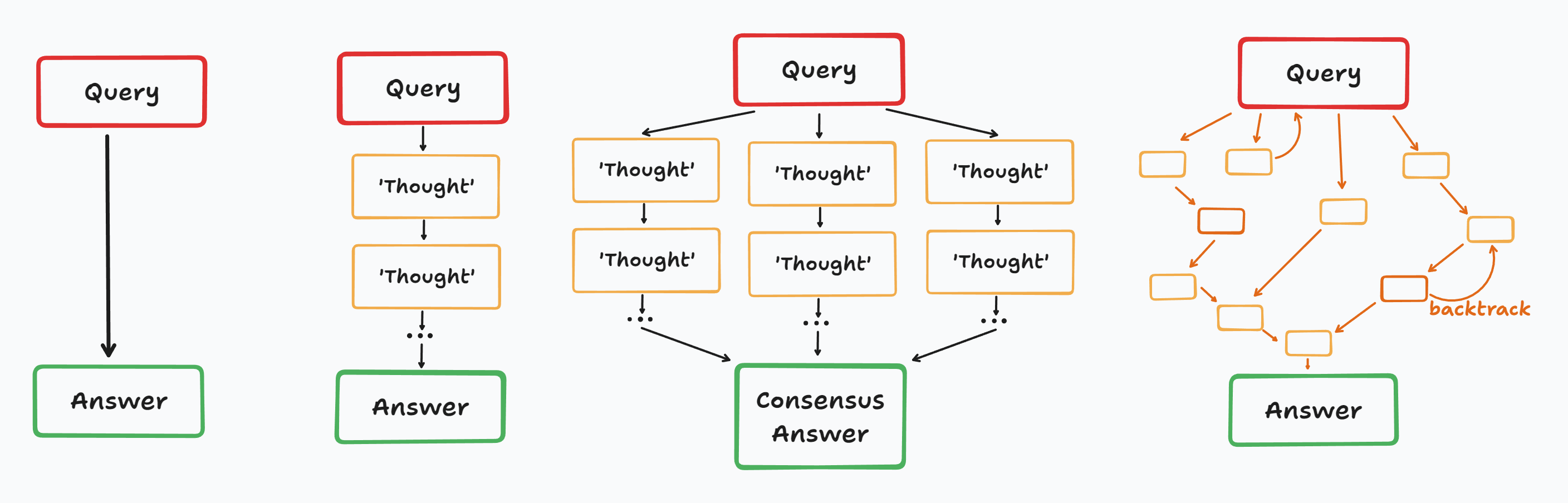
<figcaption aria-hidden="true">‘X’ of thought: different approaches to
using more inference compute before commiting to a final
answer</figcaption>
</figure>

The literature around this topic is filling up with approaches, some of
which are illustrated in the figure above. There’s ‘Chain of Thought’
where we ask the model to produce some intermediate reasoning steps
before its final answer, ‘Tree of Thought’ which constructs a tree of
possible completions, along with tons of variations that cajole
different models into debates with eachother, introduce ‘backtracking’
to try and correct mistakes partway through, and so on.

<figure>
<img src="images/alphacodium.png" alt="Alphacodium’s proposed flow" />
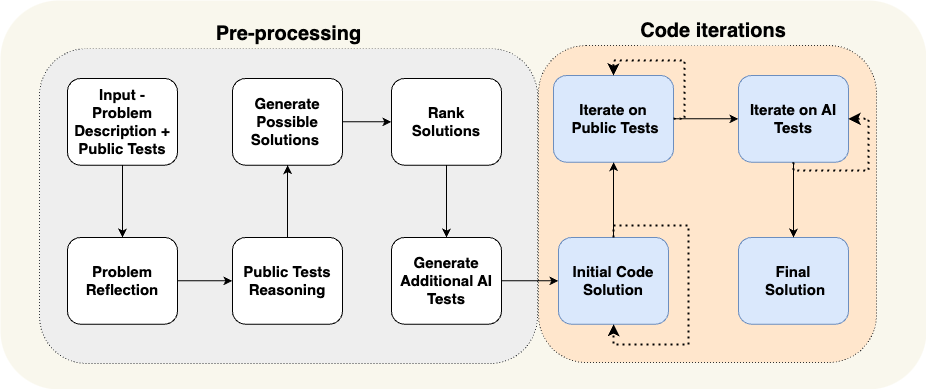
<figcaption aria-hidden="true">Alphacodium’s proposed flow</figcaption>
</figure>

The code generation ‘flow’ from
[Alphacodium](https://www.codium.ai/blog/alphacodium-state-of-the-art-code-generation-for-code-contests/)
is a good example of a complex flow tuned to a specific system. Unlike
our reward model example, they use tests (both existing tests and ones
they generate) to select from multiple candidate solutions for
programming questions. I’d like to collect more examples like this - if
you spot one in the wild please ping me on [X](x.com/johnowhitaker)!

## Conclusions

So there we have it, a few examples of how MORE can lead to BETTER.
There are many more directions you could take things: - Applying similar
ideas to training (for example, [generating samples then picking the
best to finetune with](https://arxiv.org/abs/2304.06767))

- Exploring more complex approaches to searching the space of possible
  completions (the mythical Q\* anyone?)

- Finding ways to dynamically allocate more compute for ‘difficult’
  tokens (for example, [Mixture of
  Depths](https://arxiv.org/abs/2404.02258)

- Coming up with new ways to quantify what ‘good’ means in specific
  domains

There’s a point of view that spending this time to get more out of
existing models like this is futile in the face of the next big one (TM)
which will do even better without any tricks. I don’t buy it! As we get
faster, cheaper, better models, I believe that finding ways to boost
them even further will continue to be worth it. I hope this post
inspires you to explore this too :)