# Efficient finetuning of Llama 3 with FSDP QDoRA
Kerem Turgutlu
2024-04-22

## Introduction

> *This introductory note is from Answer.AI co-founder Jeremy Howard.
> The remainder of the article after this section is by Kerem Turgutlu
> and the Answer.AI team.*

When Eric and I created Answer.AI, a key foundation of our research
thesis was based on two trends we expected to see:

1.  A dramatic increase in the size and capability of open source models
2.  Much larger opportunities for finetuning these models, using
    “continued pre-training”. (You can learn more about my thoughts on
    this in my “Latent Space” podcast interview, [The End of
    Finetuning](https://www.latent.space/p/fastai)).

A few days ago, our expectations were realized when Meta announced their
Llama 3 models. The largest will have over 400 billion parameters and,
although training isn’t finished, it is already matching OpenAI and
Anthropic’s best LLMs. Meta also announced that they have continuously
pre-trained their models at far larger scales than we’ve seen before,
using millions of carefully curated documents, showing greatly improved
capability from this process.

From the day we launched the company, we’ve been working on the
technologies necessary to harness these two trends. Last month, we
completed the first step, releasing FSDP/QLoRA, which for the first time
allowed large 70b models to be finetuned on gaming GPUs. This helps a
lot with handling larger models.

Today we’re releasing the next step: *QDoRA*. This is just as memory
efficient and scalable as FSDP/QLoRA, and critically is *also* as
accurate for continued pre-training as full weight training. We think
that this is likely to be the best way for most people to train[1]
language models. We’ve ran preliminary experiments on Llama 2, and
completed some initial ones on Llama 3. The results are extremely
promising.

I expect that QDoRA with Llama 3 will allow open source developers to
create better models for their tasks than anything that exists today,
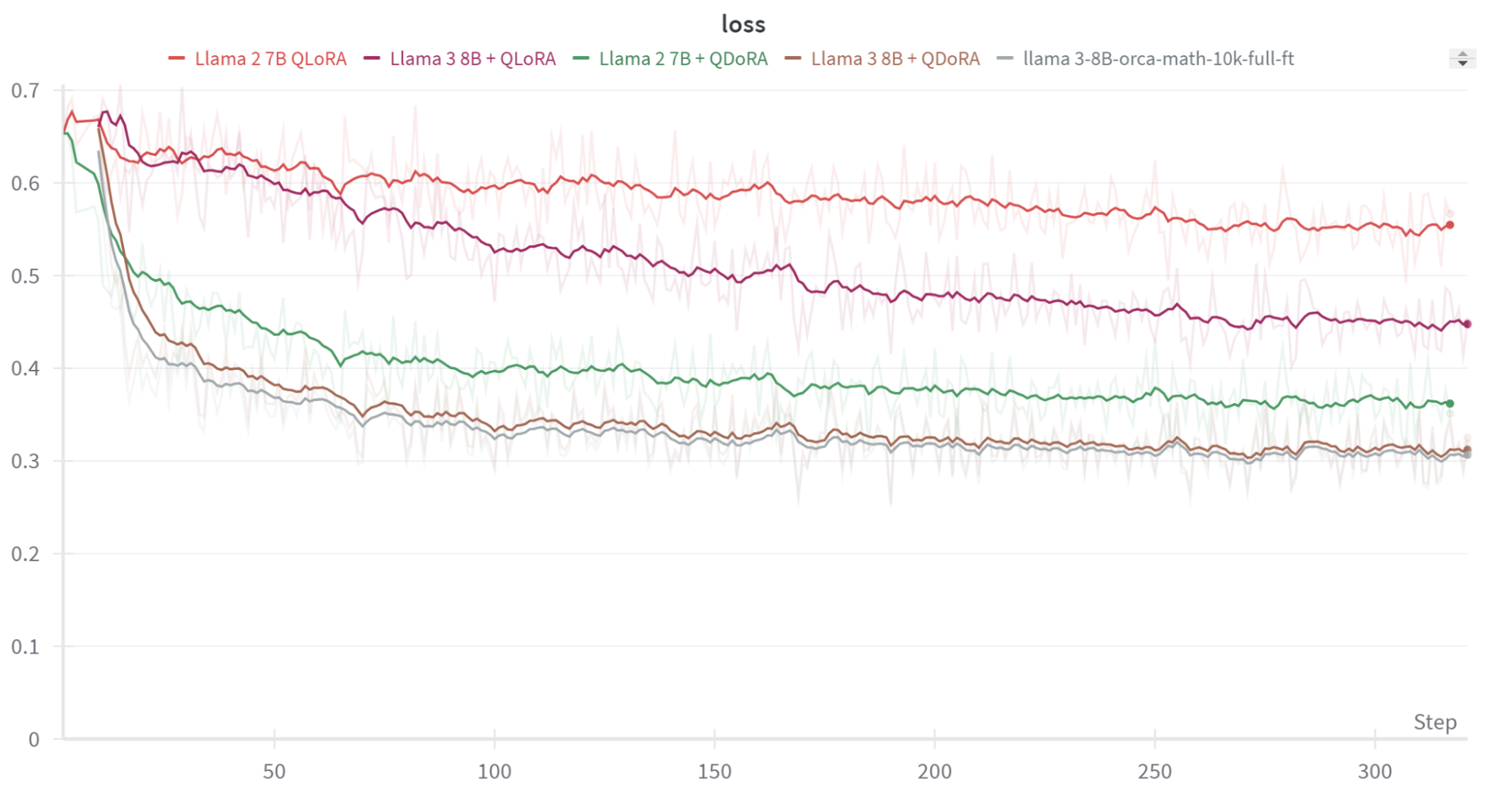
free or paid. Here’s a taste of the very impressive out-of-the-box
results we’ve seen, showing Llama3 with QDoRA, or with full finetuning,
greatly outperforming QLoRA and Llama2 when training on mathematical
data (and note that full finetuning uses far more memory than the other
approaches):

<figure>
<img src="images/qdora-llama3/image6.png"
alt="Comparison of the loss curves of Llama3-8B + QLoRA, Llama3-8B + QDoRA against the equivalent Llama2 7B training runs and Llama3-8B full-finetune." />
<figcaption aria-hidden="true">Comparison of the loss curves of
Llama3-8B + QLoRA, Llama3-8B + QDoRA against the equivalent Llama2 7B
training runs and Llama3-8B full-finetune.</figcaption>
</figure>

I particularly want to highlight the exceptional work done by Kerem
Turgutlu in kicking off and leading this project. Kerem was one of my
masters students at the University of San Francisco years ago, and he
really stood out with his creativity, work ethic, and intellect. I was
very confident he was going to achieve great things – and I very much
hoped that we could work together one day. With Answer.AI, I hoped that
we had created just the kind of environment that Kerem, and others like
him, could reach their full potential. It looks like we may have done
just that!

## Launching 2 new scalable training methods

> \*If you’re not familiar with FSDP and LoRA already, please first read
> our article <https://www.answer.ai/posts/2024-03-06-fsdp-qlora.html>
> to learn about the fundamentals on top of which today’s work is built.

Today we’re launching two significant quantized parameter efficient
training methods with FSDP compatibility, DoRA (Weight-Decomposed
Low-Rank Adaptation) and Llama-Pro (Progressive LLaMA with Block
Expansion). These methods are available for use now at the [FSDP
QLoRA](https://github.com/AnswerDotAI/fsdp_qlora) github repository -
see [Code and Models](#code-and-models) to get started.

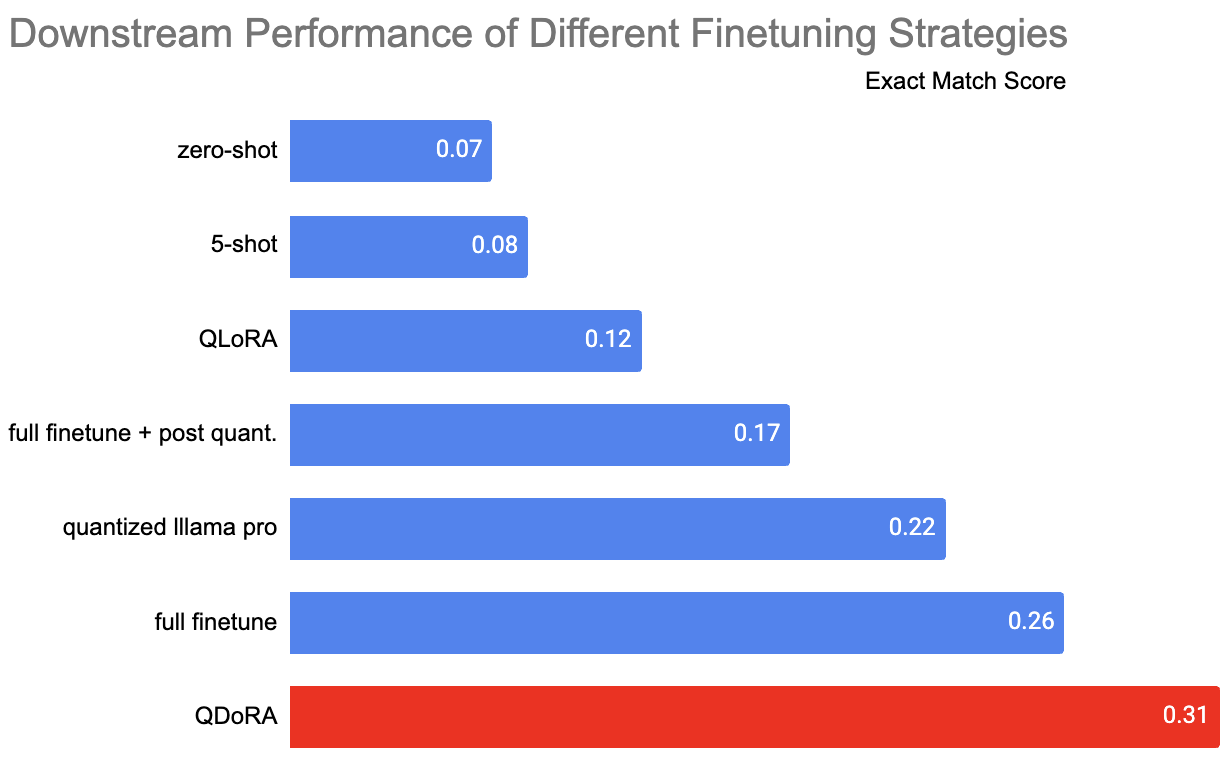
Our early results suggest that QDoRA (“Quantized DoRA”) is especially
valuable. There are no other libraries offering QDoRA or quantized
Llama-Pro training with FSDP support that we know of. You can see the
results fine tuning Llama 2 on the
[Orca-Math](https://www.microsoft.com/en-us/research/blog/orca-math-demonstrating-the-potential-of-slms-with-model-specialization/)
dataset below, where the low-memory QDoRA (quantized DoRA)
implementation produces better performance than other methods, whilst
using much less memory than full fine-tuning:[2]

<figure>
<img src="images/qdora-llama3/image1.png"
alt="Preliminary Llama-2 7B Orca-Math finetuning results without hyperparameter tuning." />
<figcaption aria-hidden="true">Preliminary Llama-2 7B Orca-Math
finetuning results without hyperparameter tuning.</figcaption>
</figure>

In essence, DoRA combines much of the parameter efficiency of plain
QLoRA with the more granular optimization of full finetuning. Using our
code, you can use these methods right now for efficient finetuning the
most popular open source LLM models including Llama 3 on your own GPUs.

Intrigued? In the sections below, this article will cover the following
areas:

- **Explanation**. Summarizing DoRA and Llama-Pro, to provide a working
  intuition for how these two optimizations work.
- **Deep Dive**. Discussing the training setup, benchmarks, and code you
  can use to run these training optimizations yourself. This benchmark
  results compare the performance of different training methods, using
  the [Orca-Math
  dataset](https://huggingface.co/datasets/microsoft/orca-math-word-problems-200k)
- **Hosting**. Discussing current options for hosting, a topic which
  requires special care since not all hosting frameworks support such
  optimized models
- **Future Work**. Covering future improvements on production-ready
  inference and optimized fused kernels for quantized LoRA, DoRA..
- **The release of Llama-3**. Discussing the potential impact of
  ever-improving open source base models, and how to leverage our work
  with them.

## LoRA

Inspired by prior work, Hu et al[3] hypothesized that most finetuning
updates operate at a low intrinsic rank. In other words, updating all
the model’s parameters during finetuning is unnecessary, we should be
able to finetune models by only updating a subset of parameters.
Low-Rank Adaptation (LoRA) implements this idea by freezing the original
linear layer weights and instead training a low dimension
reparameterization. The output of the frozen layer and trainable LoRA
layer are combined to produce the finetuned output.

This setup, especially when combined with quantization such as QLoRA,
greatly reduces the memory requirements of finetuning models and
popularized Parameter-Efficient Fine-Tuning (PEFT) methods.

While LoRA often matches or nearly matches full finetuning performance,
there are cases where it cannot match full finetuning performance, as
observed by AnyScale in their [in-depth comparison of LoRA and full
finetuning](https://www.anyscale.com/blog/fine-tuning-llms-lora-or-full-parameter-an-in-depth-analysis-with-llama-2).

## DoRA

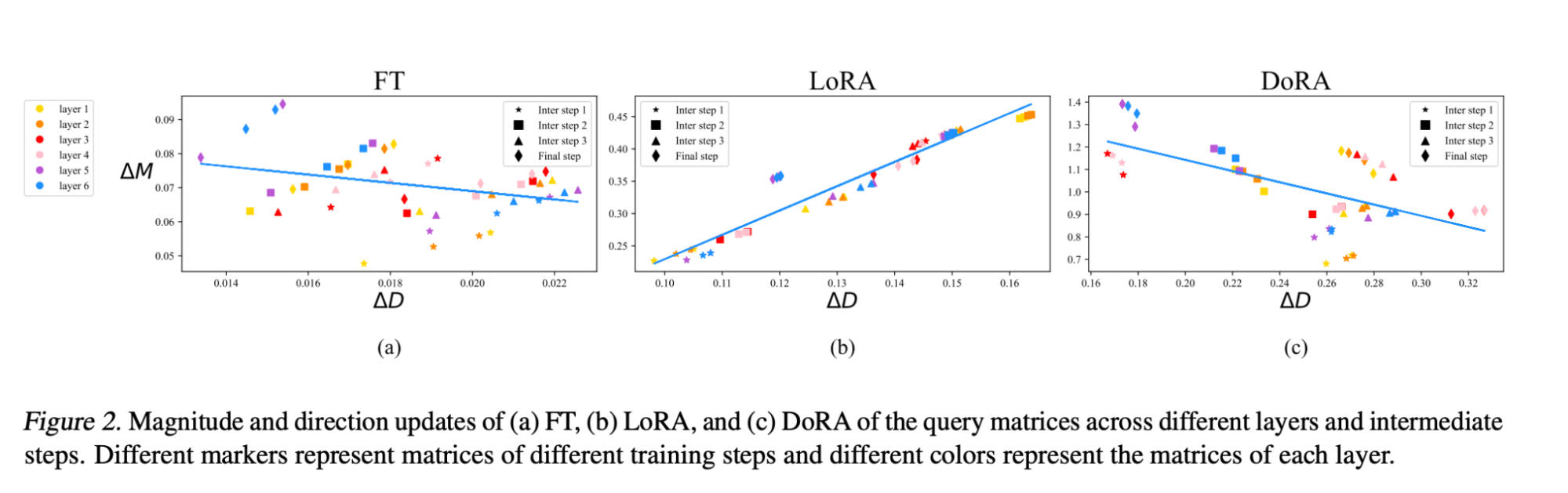
In *DoRA: Weight-Decomposed Low-Rank Adaptation*, Liu et al[4]
investigated the capacity gap between LoRA and full finetuning. Inspired
by Weight Normalization, they proposed splitting the LoRA layers into
two components, one for magnitude and one for direction, and finetuning
both. This decomposition allows DoRA to better match the performance of
full finetuning while adding a marginal number of parameters to train
relative to LoRA.

<figure>
<img src="images/qdora-llama3/image2.png"
alt="Figure 2 from Liu et al shows that while DoRA doesn’t completely match full finetuning, DoRA’s magnitude and direction modifications are more closely correlated with full finetuning while LoRA’s updates are not." />
<figcaption aria-hidden="true">Figure 2 from Liu et al shows that while
DoRA doesn’t completely match full finetuning, DoRA’s magnitude and
direction modifications are more closely correlated with full finetuning
while LoRA’s updates are not.</figcaption>
</figure>

As seen from the weight decomposition analysis in Figure 2. of the DoRA
paper, full finetuning (FT) independently optimizes the direction and
magnitude of updates to weights. LoRA only updates them in tandem. DoRA
is the best of both worlds: it updates them independently, like normal
FT, but with the parameter efficiency of LoRA.

Our implementation of FSDP-compatible QDoRA mirrors our QLoRA
implementation. Existing pretrained layers are frozen and quantized
using bitsandbytes normalized 4-bit float 4 (BnB NF4) or [half-quadratic
quantization (HQQ)](https://github.com/mobiusml/hqq) 4-bit formats and
are applied to most linear layers, specifically the attention query,
key, and value layers and the MLP upscale, gating, and downscale layers.
These trainable QDoRA layers represent approximately two percent of the
total model parameters.

## Llama-Pro

In *LLaMA Pro: Progressive LLaMA with Block Expansion*, Wu et al[5]
explores an innovative method for enhancing large language models (LLMs)
through a technique called *block expansion*.

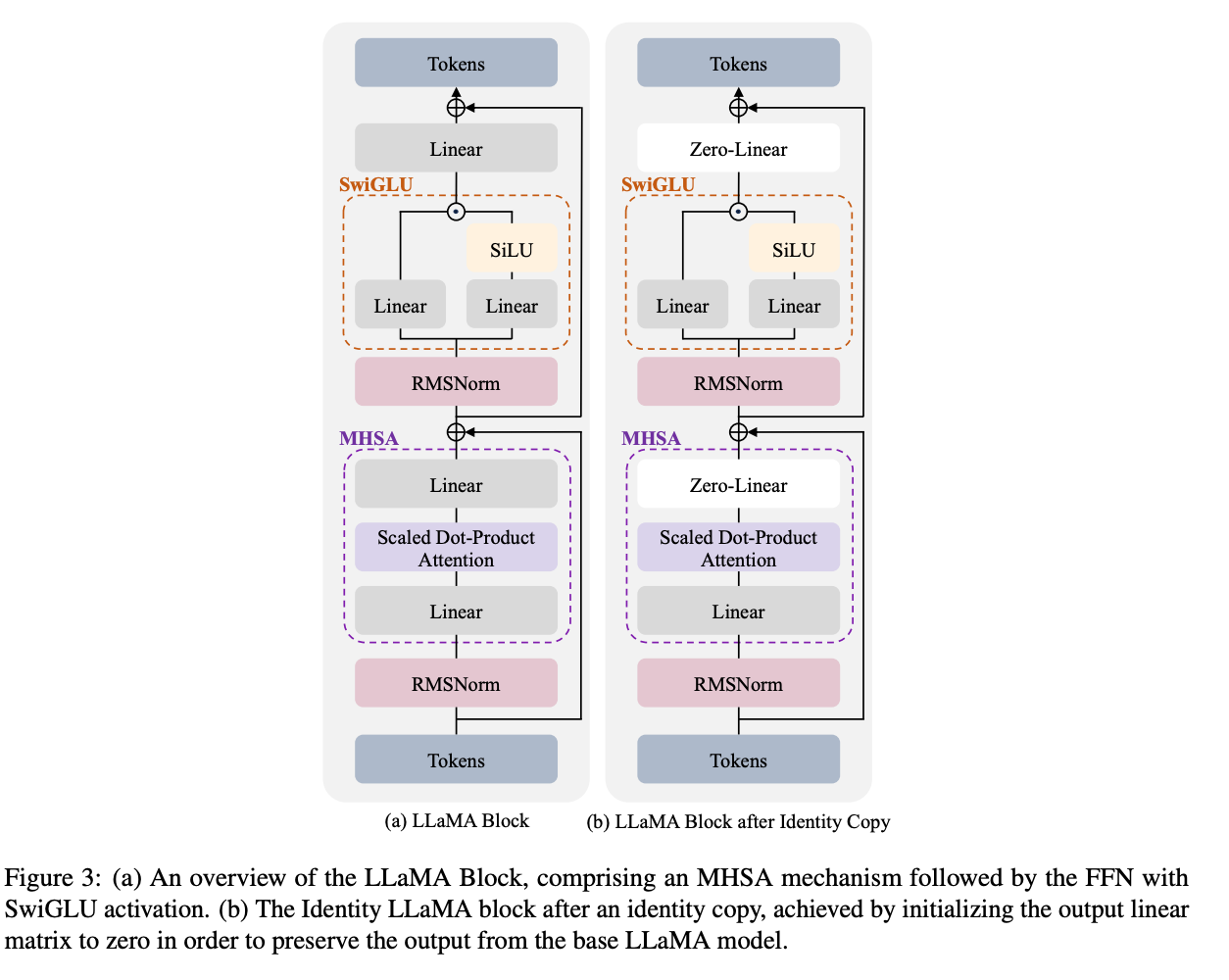
This technique strategically adds Transformer blocks to improve model
specialization without sacrificing existing capabilities. Specifically,
it interleaves new transformer decoder layers which are initialized as
identity functions to maintain model output while integrating new,
domain-specific information from tailored datasets such as programming
and mathematics. This approach allows the model to extend its depth and
refine its specialization areas, providing an advantageous blend of
broad general knowledge and sharp, domain-specific expertise without the
common downsides of full model retraining or extensive finetuning. The
main motivation is to keep the original pretrained weights unchanged and
train new layers with skip connections (like resnets) initialized from
identity blocks to add new capabilities. So in the perfect scenario, the
model should have no regressions from the past training tasks.

In the [original
implementation](https://github.com/TencentARC/LLaMA-Pro/blob/main/scripts/block_expansion.py)
of the Llama-Pro, a number of new trainable decoder blocks are
interleaved. In our experiments, we follow a similar approach by adding
a new decoder block after every 10 layers while quantizing the frozen
layers. This is referred to as a 10% expansion rate, which is another
hyperparameter that can be tuned depending on the task complexity. These
new decoder layers are initialized with the same weights from the
preceding layer except for down and output projection layers which are
zero-initialized to make the new decoder layer an identity layer.

<figure>
<img src="images/qdora-llama3/image3.png"
alt="Figure 3. from Llama-Pro paper contrasting a regular transformer decoder layer block vs a new block added after block expansion. MHSA (Multi-head Self Attention) and FFN (Feed Forward Network)." />
<figcaption aria-hidden="true">Figure 3. from Llama-Pro paper
contrasting a regular transformer decoder layer block vs a new block
added after block expansion. MHSA (Multi-head Self Attention) and FFN
(Feed Forward Network).</figcaption>
</figure>

## Training Performance

### Training and Evaluation Setup

In most of our experiments we used the Llama-2-7b base model (our work
started before the Llama-3 release), the Orca-Math dataset and the
following hyperparameters:

<table>
<colgroup>
<col style="width: 37%" />
<col style="width: 62%" />
</colgroup>
<thead>
<tr>
<th>Parameter</th>
<th>Value</th>
</tr>
</thead>
<tbody>
<tr>
<td>Epoch</td>
<td>1</td>
</tr>
<tr>
<td>Precision</td>
<td>bf16</td>
</tr>
<tr>
<td>Batch Size</td>
<td>32</td>
</tr>
<tr>
<td>Optimizer</td>
<td>AdamW</td>
</tr>
<tr>
<td>Learning Rate</td>
<td>1e-5</td>
</tr>
<tr>
<td>Learning Rate Schedule</td>
<td>Constant</td>
</tr>
<tr>
<td>Weight Decay</td>
<td>0.1</td>
</tr>
<tr>
<td>Context Length</td>
<td>2048</td>
</tr>
<tr>
<td>LoRA Rank</td>
<td>64</td>
</tr>
<tr>
<td>LoRA Target Modules</td>
<td>k_proj, q_proj, v_proj, up_proj, down_proj, gate_proj</td>
</tr>
<tr>
<td>Llama-Pro Expansion Rate</td>
<td>0.1</td>
</tr>
</tbody>
</table>

The dataset contains ~200K grade school math word problems. All the
answers in this dataset are generated using GPT4-Turbo. You may refer to
[Orca-Math: Unlocking the potential of SLMs in Grade School
Math](https://arxiv.org/abs/2402.14830) for details about the dataset
construction. Math is a good testbed for general reasoning skills and it
is easier to evaluate compared to more open-ended tasks such as
chatbots.

We extract the ground truth labels of the Orca-Math dataset using regex,
which identifies the last occurrence of digits that may include leading
currency symbols, decimal points, and ratios. We use the exact match
score as the evaluation metric. The same set of experiments is conducted
with small and large training sample sizes, 10k and 100k respectively.
500 samples are held out for evaluation. In addition to
quantization-aware trained models, we also evaluated zero-shot,
few-shot, and full finetuning with post-quantization, where all
parameters of the model are trained and later quantized with BnB NF4.

### Results

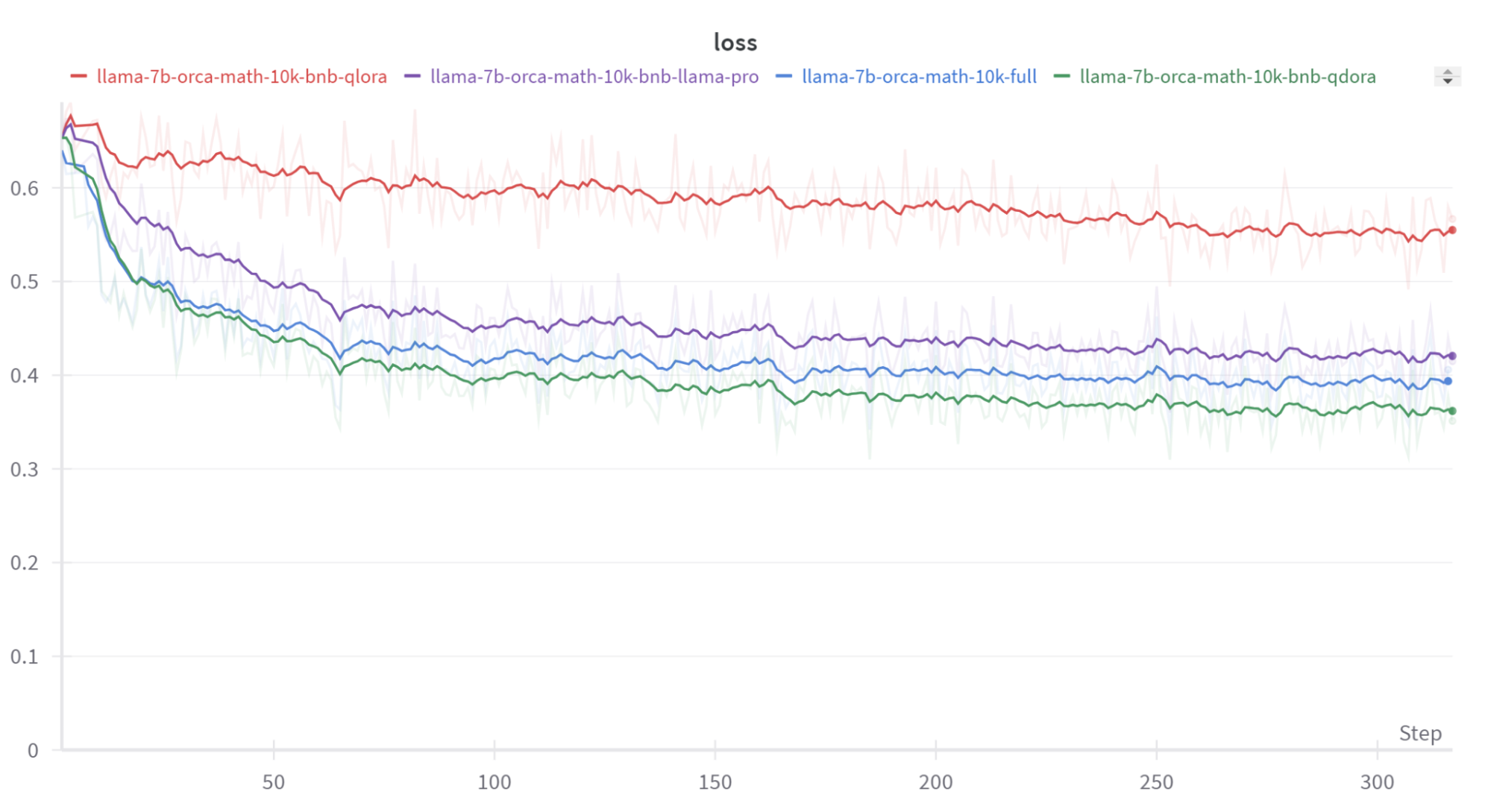
<figure>
<img src="images/qdora-llama3/image4.png"
alt="Loss curve of Full Fine-tuning, BnB QLoRA, BnB QDoRA, and BnB Llama-Pro trained models with 10k samples." />
<figcaption aria-hidden="true">Loss curve of Full Fine-tuning, BnB
QLoRA, BnB QDoRA, and BnB Llama-Pro trained models with 10k
samples.</figcaption>
</figure>

<table>
<caption>Evaluation results of Zero-Shot, Few-Shot, Full Fine-tuning,
Full Fine-tuning Post Quantization, BnB QLoRA, BnB QDoRA, and BnB
Llama-Pro trained models with 10k samples.</caption>
<colgroup>
<col style="width: 12%" />
<col style="width: 27%" />
<col style="width: 20%" />
<col style="width: 19%" />
<col style="width: 20%" />
</colgroup>
<thead>
<tr>
<th>Model</th>
<th>Method</th>
<th>Train sample size</th>
<th>Eval sample size</th>
<th>Exact match score</th>
</tr>
</thead>
<tbody>
<tr>
<td>llama-2-7b</td>
<td>zero-shot</td>
<td>-</td>
<td>500</td>
<td>0.068</td>
</tr>
<tr>
<td>llama-2-7b</td>
<td>5-shot</td>
<td>-</td>
<td>500</td>
<td>0.08</td>
</tr>
<tr>
<td><strong>llama-2-7b</strong></td>
<td><strong>full finetune</strong></td>
<td><strong>10k</strong></td>
<td><strong>500</strong></td>
<td><strong>0.182</strong></td>
</tr>
<tr>
<td>llama-2-7b</td>
<td>full finetune + post quant.</td>
<td>10k</td>
<td>500</td>
<td>0.14</td>
</tr>
<tr>
<td>llama-2-7b</td>
<td>QLoRA</td>
<td>10k</td>
<td>500</td>
<td>0.098</td>
</tr>
<tr>
<td><strong>llama-2-7b</strong></td>
<td><strong>QDoRA</strong></td>
<td><strong>10k</strong></td>
<td><strong>500</strong></td>
<td><strong>0.176</strong></td>
</tr>
<tr>
<td>llama-2-7b</td>
<td>quantized llama pro</td>
<td>10k</td>
<td>500</td>
<td>0.134</td>
</tr>
</tbody>
</table>

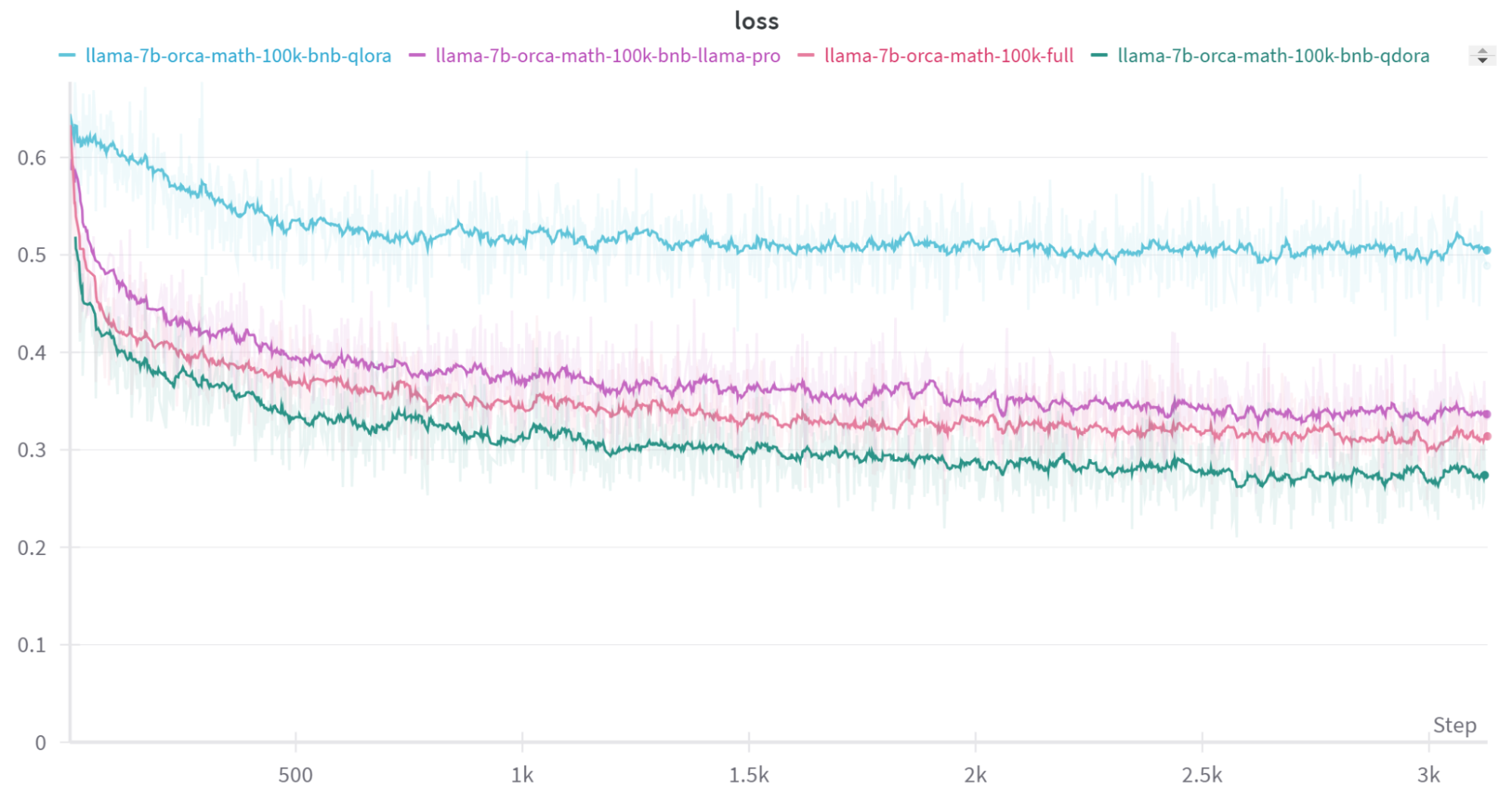
<figure>
<img src="images/qdora-llama3/image5.png"
alt="Loss curve of Full Fine-tuning, BnB QLoRA, BnB QDoRA, and BnB Llama-Pro trained models with 100k samples." />
<figcaption aria-hidden="true">Loss curve of Full Fine-tuning, BnB
QLoRA, BnB QDoRA, and BnB Llama-Pro trained models with 100k
samples.</figcaption>
</figure>

<table>
<caption>Evaluation results of Zero-Shot, Few-Shot, Full Fine-tuning,
Full Fine-tuning Post Quantization, BnB QLoRA, BnB QDoRA, and BnB
Llama-Pro trained models with 100k samples.</caption>
<colgroup>
<col style="width: 12%" />
<col style="width: 29%" />
<col style="width: 19%" />
<col style="width: 18%" />
<col style="width: 19%" />
</colgroup>
<thead>
<tr>
<th>Model</th>
<th>Method</th>
<th>Train sample size</th>
<th>Eval sample size</th>
<th>Exact match score</th>
</tr>
</thead>
<tbody>
<tr>
<td>llama-2-7b</td>
<td>zero-shot</td>
<td>-</td>
<td>500</td>
<td>0.068</td>
</tr>
<tr>
<td>llama-2-7b</td>
<td>5-shot</td>
<td>-</td>
<td>500</td>
<td>0.08</td>
</tr>
<tr>
<td>llama-2-7b</td>
<td>full finetune</td>
<td>100k</td>
<td>500</td>
<td>0.26</td>
</tr>
<tr>
<td>llama-2-7b</td>
<td>full finetune + post quant.</td>
<td>100k</td>
<td>500</td>
<td>0.168</td>
</tr>
<tr>
<td>llama-2-7b</td>
<td>QLoRA</td>
<td>100k</td>
<td>500</td>
<td>0.118</td>
</tr>
<tr>
<td><strong>llama-2-7b</strong></td>
<td><strong>QDoRA</strong></td>
<td><strong>100k</strong></td>
<td><strong>500</strong></td>
<td><strong>0.312</strong></td>
</tr>
<tr>
<td>llama-2-7b</td>
<td>quantized llama pro</td>
<td>100k</td>
<td>500</td>
<td>0.134</td>
</tr>
</tbody>
</table>

The key insight from this preliminary study is QDoRA’s edge as a top
choice among other quantized, parameter-efficient methods. In our
experiments to date, it matches or exceeds the performance of full
finetuning, but requires far less memory. (We expect extensive
hyperparameter optimization might ultimately push full finetuning to
yield the best results, but we have not observed this in our tests.)

While post-quantization significantly degrades performance, it’s worth
mentioning that we used BnB NF4 for post-quantization—a weight-only
quantization method. Using activation-aware quantization methods like
AWQ or GPTQ should improve results, though these methods can’t be used
with quantization-aware finetuning and may be susceptible to data biases
and shifts. Additionally, the advanced quantization-aware finetuning
techniques introduced here are set to revolutionize training for the
largest open-source models using FSDP. They promise to cut GPU server
costs dramatically while still closely approximating the performance of
full finetuning.

## Code and Models

To train your own quantization aware fine-tuned models or to reproduce
our results you can take a look at the different training options
available
[here](https://github.com/AnswerDotAI/fsdp_qlora?tab=readme-ov-file#training-options) -
which is from the original [FSDP-QLoRA github
repo](https://github.com/AnswerDotAI/fsdp_qlora). You can also access
all the trained models from our [Hugging Face
collection](https://huggingface.co/collections/answerdotai/quantized-ft-orca-math-661eafb3db85e1ae77a3ffda).

To train with QDoRA using the same 10k Orca-Math samples:

``` bash
# Assuming 4 GPUs, if different adjust `gradient_accumulation_steps` to make bs=32.
python fsdp_qlora/train.py \
--train_type bnb_dora \
--model_name meta-llama/Llama-2-7b-hf \
--dataset orca_math \
--dataset_samples 10000 \
--batch_size 4 \
--context_length 2048 \
--gradient_accumulation_steps 2 \
--sharding_strategy full_shard \
--use_gradient_checkpointing true \
--reentrant_checkpointing true \
--use_cpu_offload false \
--use_activation_cpu_offload false \
--log_to wandb \
--project_name "fsdp-quantized-ft-exps" \
--save_model true \
--output_dir models/llama-7b-orca-math-10k-bnb-QDoRA
```

Before Llama-Pro training you need to prepare the expanded version of
the model weights to be used during model initialization:

``` bash
# Adds a new block after every 10 blocks and saves the weights to directory.
python fsdp_qlora/scripts/block_expansion.py \
--model_name meta-llama/Llama-2-7b-hf \
--output_dir /path/to/llama_pro_weights_directory \
--expansion_rate 0.1
```

To train with Llama-Pro:

``` bash
# Assuming 4 GPUs, if different adjust `gradient_accumulation_steps` to make bs=32.
python fsdp_qlora/train.py \
--train_type bnb_llama_pro \
--llama_pro_path /path/to/llama_pro_weights_directory \
--model_name meta-llama/Llama-2-7b-hf \
--dataset orca_math \
--dataset_samples 10000 \
--batch_size 4 \
--context_length 2048 \
--gradient_accumulation_steps 2 \
--sharding_strategy full_shard \
--use_gradient_checkpointing true \
--reentrant_checkpointing true \
--use_cpu_offload false \
--use_activation_cpu_offload false \
--log_to wandb \
--project_name "fsdp-quantized-ft-exps" \
--save_model true \
--output_dir models/llama-7b-orca-math-10k-bnb-qdora
```

In the above examples, you can replace the training type with `hqq_dora`
and `hqq_llama_pro` to use HQQ 4-bit quantization instead of BnB.

To evaluate the trained models on Orca-Math dataset you can refer to our
standalone [evaluation python
script](https://github.com/AnswerDotAI/fsdp_qlora/blob/e454d3180ef575654279d6ac444a86cb0bb3ff33/evaluate.py)
and [evaluation bash
script](https://github.com/AnswerDotAI/fsdp_qlora/blob/e454d3180ef575654279d6ac444a86cb0bb3ff33/evaluate.sh).
This evaluation script uses HF’s `model.generate()` method to evaluate
the exact match score between the ground truth answers and the generated
text. Using this method on very large datasets is not recommended as it
is neither optimized nor suitable for production deployment.

Next, we will take a look at how we can overcome the slow inference
problem and potentially make inference much more efficient.

## Inference

As we’ve discussed, the QDoRA optimizations allow much faster training.
However, they also require some corresponding changes in the inference
framework, in order to be able to serve the modified models efficiently.

We looked at [vLLM](https://github.com/vllm-project/vllm). vLLM is a
robust, production-ready framework designed for serving LLM endpoints,
offering high throughput and good latency. You can learn more about it
in an
[article](https://betterprogramming.pub/frameworks-for-serving-llms-60b7f7b23407)
on Better Programming which compares and contrasts different frameworks
for deploying LLMs. vLLM already supports various quantization methods
such as AWQ, GPTQ, SqueezeLLM, and Marlin. Unfortunately, the main
branch of vLLM does not currently support weight-only quantization
libraries like the ones which we use, BnB and HQQ.

As an initial effort to serve quantization-aware finetuned models, we
added BnB and assessed the post-quantization and QDoRA inference
performance. Although this implementation is still inefficient and not
thoroughly optimized, it performs better than the vanilla HF
`generate()`. Our experimental implementation only works in eager mode
and does not work with the [CUDA
graphs](https://developer.nvidia.com/blog/cuda-graphs/) mode in vLLM.
Using vLLM’s eager mode, a performance improvement of 1.5-2x can be
achieved. This
[article](https://blog.fireworks.ai/speed-python-pick-two-how-cuda-graphs-enable-fast-python-code-for-deep-learning-353bf6241248)
from Fireworks.ai explains the benefits of using CUDA graphs in the
context of decoder-only LLM inference. To enable CUDA graph mode,
modifications related to CUDA streams might be necessary, as discussed
in this [PR](https://github.com/vLLM-project/vLLM/pull/2497). Also, our
QDoRA layer is not implemented as a fused kernel, meaning that
sequential and separate CUDA kernel launches are required to dequantize,
to merge the pretrained weights and LoRA weights, and to compute the
final matrix multiplication - we will talk more about potential
optimizations in the Future Work section. You can explore our
[experimental vLLM
branch](https://github.com/AnswerDotAI/vllm/blob/bnb_quant/vllm/model_executor/layers/quantization/bnb.py)
for more details and how the BnB quantization method is integrated into
vLLM.

We evaluated throughput and latency of the following models: full
finetuned (FFT) post quantized (BnB NF4), QDoRA with separate quantized
and LoRA weights, QDoRA with merged weights, and a
[GPTQ-Marlin](https://github.com/IST-DASLab/marlin/blob/master/assets/sustained.png)
post-quantized version of the QDoRA merged model. GPTQ-Marlin FP16x4bit
matmul kernel offers the best speedup compared to other methods
according to their benchmark results. Note that the QDoRA model with
merged weights doesn’t save any memory as the quantized weights are
dequantized and merged with LoRA layers. So it is effectively the same
as serving a non-quantized model. During GPTQ-Marlin quantization, after
merging the QDoRA weights we quantized the model using 3000 samples from
the same Orca-Math dataset used during training. We adapted the code
from [here](https://github.com/IST-DASLab/marlin/tree/master/gptq).

In our experiments, we also tested tensor parallelism by using multiple
GPUs, in which the matrix multiplications are parallelized with either
row-parallelism or column parallelism in different layers of the model.
Our multi-GPU machine with 4xA5000 is rented from RunPod, which does not
have an optimal topology, so the multi-GPU results could be further
improved with better interconnect configurations, such as NVLinks.
During inference benchmarks, 50 hold-out samples from the validation set
were used to compute the exact match score. Variable results were
observed, which can be attributed to the tensor-parallelism algorithm.

<table>
<caption>As a reference vanilla HF <code>generate()</code> method using
FFT (full finetune) + post quantization attains a throughput of 7
req/min.</caption>
<colgroup>
<col style="width: 12%" />
<col style="width: 10%" />
<col style="width: 14%" />
<col style="width: 11%" />
<col style="width: 12%" />
<col style="width: 11%" />
<col style="width: 13%" />
</colgroup>
<thead>
<tr>
<th>Model</th>
<th>Compilation Mode</th>
<th>Model Compr. Rate</th>
<th>TP</th>
<th>Throughput (req/min)</th>
<th>Throughput (tok/sec)</th>
<th>Latency (tok/sec)</th>
<th>Exact match score</th>
</tr>
</thead>
<tbody>
<tr>
<td>FFT + Post quant.</td>
<td>Eager</td>
<td>4X</td>
<td>1</td>
<td>41</td>
<td>231</td>
<td>15.6</td>
<td>0.16</td>
</tr>
<tr>
<td>FFT + Post quant.</td>
<td>Eager</td>
<td>4X</td>
<td>2</td>
<td>65</td>
<td>389</td>
<td>27.5</td>
<td>0.2</td>
</tr>
<tr>
<td>FFT + Post quant.</td>
<td>Eager</td>
<td>4X</td>
<td>4</td>
<td>74</td>
<td>381</td>
<td>28.1</td>
<td>0.2</td>
</tr>
<tr>
<td>QDoRA BNB</td>
<td>Eager</td>
<td>4X</td>
<td>1</td>
<td>15</td>
<td>76</td>
<td>5.4</td>
<td>0.24</td>
</tr>
<tr>
<td>QDoRA BNB</td>
<td>Eager</td>
<td>4X</td>
<td>2</td>
<td>27.5</td>
<td>152</td>
<td>9.9</td>
<td>0.22</td>
</tr>
<tr>
<td>QDoRA BNB</td>
<td>Eager</td>
<td>4X</td>
<td>4</td>
<td>50</td>
<td>271</td>
<td>18.3</td>
<td>0.24</td>
</tr>
<tr>
<td>QDoRA (merged)</td>
<td>CUDA Graphs</td>
<td>1X</td>
<td>1</td>
<td>104</td>
<td>546</td>
<td>46</td>
<td>0.42</td>
</tr>
<tr>
<td>QDoRA (merged)</td>
<td>CUDA Graphs</td>
<td>1X</td>
<td>2</td>
<td>142</td>
<td>835</td>
<td>67</td>
<td>0.36</td>
</tr>
<tr>
<td>QDoRA (merged)</td>
<td>CUDA Graphs</td>
<td>1X</td>
<td>4</td>
<td>172</td>
<td>1003</td>
<td>76</td>
<td>0.38</td>
</tr>
<tr>
<td><strong>QDoRA (merged) + GPTQ Marlin</strong></td>
<td><strong>CUDA Graphs</strong></td>
<td><strong>4X</strong></td>
<td><strong>1</strong></td>
<td><strong>194</strong></td>
<td><strong>1122</strong></td>
<td><strong>130</strong></td>
<td><strong>0.38</strong></td>
</tr>
<tr>
<td>QDoRA (merged) + GPTQ Marlin</td>
<td>CUDA Graphs</td>
<td>4X</td>
<td>2</td>
<td>200</td>
<td>1008</td>
<td>79</td>
<td>0.34</td>
</tr>
</tbody>
</table>

Experiments are conducted on the same 4xA5000 machine using the
pretrained llama-2 models with different training methods. We leverage
the existing vLLM code or our own vLLM BnB integrations where
applicable. **TP**: number of GPUs used for tensor parallelism.
**Throughput:** requests / minute and tokens / minute. **Latency:**
tokens / second, computed by sending a single request with 5 input
tokens and forcing 1024 output tokens during generation. **Exact match
score:** 50 held-out sample exact match score.

To prepare the vLLM compatible weight files from the pretrained
Orca-Math models you can refer to our standalone [python
script](https://github.com/AnswerDotAI/fsdp_qlora/blob/e454d3180ef575654279d6ac444a86cb0bb3ff33/prepare_weights.py)
and [bash
script](https://github.com/AnswerDotAI/fsdp_qlora/blob/e454d3180ef575654279d6ac444a86cb0bb3ff33/prepare_weights.sh).

Even though our custom implementation has much better performance
compared to vanilla Hugging Face Transformers, it is still not close to
optimized vLLM methods. Full finetuned and post quantized model is
nearly 5x slower compared to GPTQ Marlin, and QDoRA is 15x slower. We
can also see that GPTQ Marlin is both faster and 4x more memory
efficient than the un-quantized vLLM model (QDoRA merged). This inspires
future work to improve the weight-only quantization methods with faster
kernels, and to implement a fused QDoRA layer.

That being said, GPTQ-Marlin post-quantization following the merging of
DoRA weights could serve as a temporary solution if deploying merged
weights directly is not feasible. We are actively collaborating with the
authors of open-source quantization libraries to enhance the efficiency
of HQQ-LoRA/DoRA integrations.

## Future Work

We’ve seen in the case of work such as flash attention that IO-aware
fused kernels can provide substantial performance improvements. We’re
collaborating with others in the community to build out fused kernels
for quantization and LoRA/DoRa adapters to make the use of these
finetuning approaches more efficient in both training and inference. We
will also continue to work on enabling CUDA Graphs for BnB and HQQ in
vLLM, as well as Marlin compatible HQQ-DoRA finetuning. Feel free to
reach out if you’re interested in contributing to this effort.

## Enter Llama 3

Last Thursday, Meta AI released two potent new base models for
finetuning with the release of Llama 3 8B and 70B, with an even larger
400B+ parameters model on the way. Both of the released models have been
trained on \>15 trillion tokens, and exhibit extremely strong
performance on both [formal
benchmarks](https://ai.meta.com/blog/meta-Llama-3/) and the [LMSYS
Chatbot Arena](https://arena.lmsys.org/).

As Jeremy discussed in the introduction of this post, we believe that
powerful open source models finetuned with the right tools, will
continuously improve and yield better performance than even the
strongest proprietary models. Llama 3 represents a gigantic step in this
direction, and indeed the community is more than eager to put this
theory to the test: in the space of just a single week-end, thousands of
[Llama 3
finetunes](https://huggingface.co/models?sort=trending&search=Llama-3)
have already been uploaded to the HuggingFace model hub.

We are eager for our work to make these advances even more accessible.
The work we have done on FSDP-QLoRA and QDoRA is immediately applicable
to Llama-3: the only change necessary to use FSDP-QDoRA with Llama3 is
updating the `--model-name` parameter in the scripts above to
`meta-llama/Meta-Llama-3-{8B|70B}-{|Instruct}`.

``` bash
# Assuming 4 GPUs, if different adjust `gradient_accumulation_steps` to make bs=32.
python fsdp_qlora/train.py \
--train_type bnb_dora \
--model_name meta-llama/Meta-Llama-3-8B \
--dataset orca_math \
--dataset_samples 10000 \
--batch_size 4 \
--context_length 2048 \
--gradient_accumulation_steps 2 \
--sharding_strategy full_shard \
--use_gradient_checkpointing true \
--reentrant_checkpointing true \
--use_cpu_offload false \
--use_activation_cpu_offload false \
--log_to wandb \
--project_name "fsdp-quantized-ft-exps" \
--save_model true \
--output_dir models/Llama-3-8b-orca-math-10k-bnb-QDoRA
```

Our [training
code](https://github.com/AnswerDotAI/fsdp_qlora/blob/main/train.py)
allows for quick, efficient and powerful finetuning of the new models.
As a result, it is now within reach of the community to match
task-specific GPT-4 performance at home with a dozen lines of code.
We’re very excited to see what exciting continuously pre-trained models
will appear over the next few weeks!

## General timeline

![](images/qdora-llama3/image7.png)

## Credits

*Special thanks to Benjamin Clavié for helping with the vLLM BnB
integration, to Johno Whitaker for running the initial experiments on
Llama-3, to Alexis Gallagher for editorial comments and suggestions, and
to Austin Huang, Benjamin Warner, Griffin Adams, Eric Ries and Jeremy
Howard for reviewing and improving the initial version of this blog
post.*

[1] In this post “train” means using gradient descent to modify weights
in a model. That could be used for training random weights from scratch
(“pre-training”) or starting from pre-trained weights (“finetuning” or
“continued pre-training”). In practice, there’s very rarely any need for
starting with random weights, so nearly everyone reading this will be
interested in finetuning, and that’s all that we’ve actually tested
QDoRA with. But the term “finetuning” comes with a lot of now-obsolete
assumed limitations, and “continuous pre-training” is a bit of a
mouthful.

[2] Because Llama 3 has only just been released, we haven’t had time to
do extensive experiments yet. We’d expect that with better
hyperparameter optimization we’ll see full finetuning and QDoRA at
around the same accuracy.

[3] [Edward J. Hu, Yelong Shen, Phillip Wallis, Zeyuan Allen-Zhu,
Yuanzhi Li, Shean Wang, Lu Wang, Weizhu Chen, LoRA: Low-Rank Adaptation
of Large Language Models (2021)](https://arxiv.org/abs/2106.09685)

[4] *[Shih-Yang Liu, Chien-Yi Wang, Hongxu Yin, Pavlo Molchanov,
Yu-Chiang Frank Wang, Kwang-Ting Cheng, Min-Hung Chen, DoRA:
Weight-Decomposed Low-Rank Adaptation
(2024)](https://arxiv.org/abs/2402.09353)*

[5] [Chengyue Wu and Yukang Gan and Yixiao Ge and Zeyu Lu and Jiahao
Wang and Ye Feng and Ping Luo and Ying Shan, LLaMA Pro: Progressive
LLaMA with Block Expansion (2024)](https://arxiv.org/abs/2401.02415)